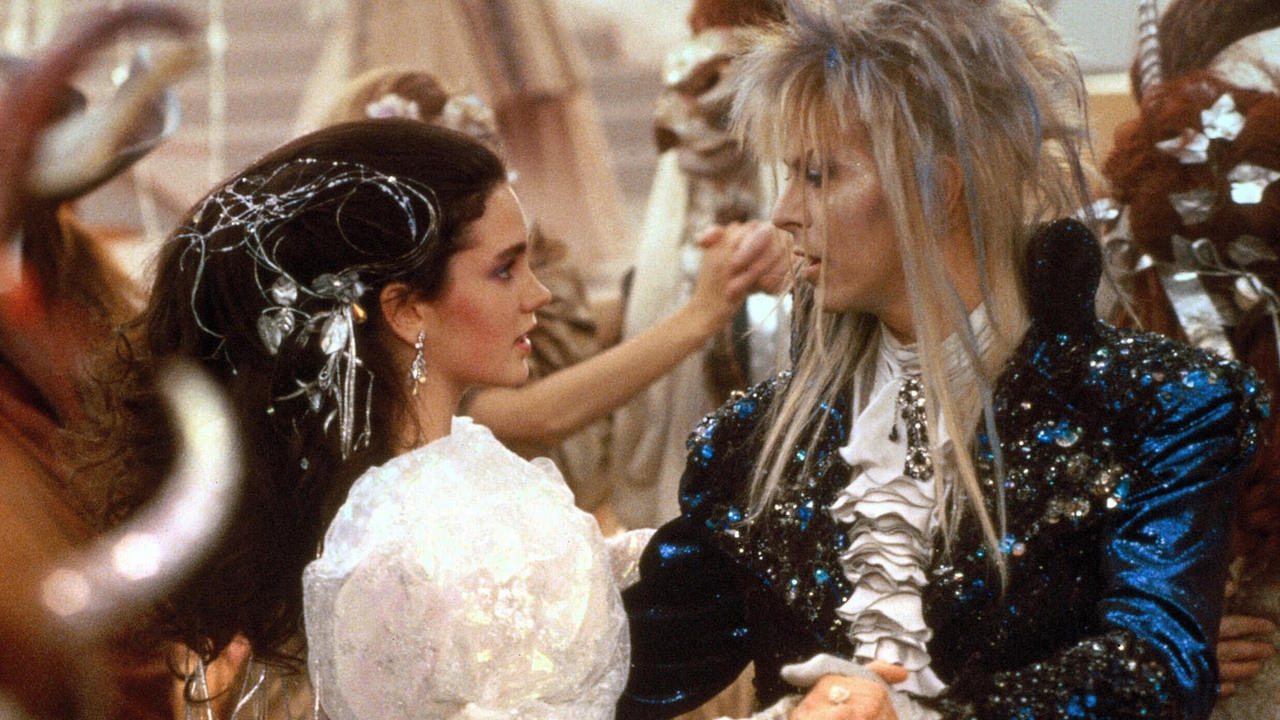
Jim Henson’s tactile world-building met David Bowie’s otherworldly charisma.
A Film That Grew With Its Audience
When Labyrinth premiered in 1986, it was met with confusion rather than celebration. Audiences and critics didn’t quite know what to do with it. Too dark for children, too whimsical for adults, and too emotionally ambiguous to fit neatly into the fantasy canon of its time, the film underperformed at the box office and received mixed critical responses. Many reviews struggled with its tonal shifts, while others dismissed it as visually inventive but narratively slight.
What’s striking is how the film’s reception evolved alongside its audience. Those who first encountered Labyrinth as children often returned to it later with new eyes, discovering layers of melancholy, agency, and resistance that had gone unnoticed before. In this way, Labyrinth became less a cult classic and more a shared emotional text, one that grows with its viewers rather than speaking to them only once.
At its core, Labyrinth was never just about magic or goblins. Sarah’s (Jennifer Connelly) journey through the maze mirrors the emotional chaos of growing up: the desire for control, the fear of responsibility, the temptation to stay suspended in fantasy forever.
Films That Carry the Same Spirit
The Dark Crystal (USA, 1982)
Dir. Jim Henson & Frank Oz
My take: A fully realised fantasy world where puppetry becomes political myth.
On another planet in the distant past, the last of the Gelfling race embarks on a quest to find the missing shard of a magical crystal and to restore order to his world. (IMDb)
Pan’s Labyrinth (Spain/Mexico, 2006)
Dir. Guillermo del Toro
My take: Fantasy as refuge and resistance under authoritarian violence.
In 1944 Spain, a girl is sent to live with her ruthless stepfather. During the night, she meets a fairy who takes her to an old faun. He tells her she’s a princess, but must prove her royalty by surviving three gruesome tasks. (IMDb)
Spirited Away (Japan, 2001)
Dir. Hayao Miyazaki
My take: A liminal coming-of-age tale shaped by loss, memory, and transformation.
During her family’s move to the suburbs, a sullen 10-year-old girl wanders into a world ruled by gods, witches and spirits, and where humans are changed into beasts. (IMDb)
A Chinese Ghost Story (British Hong Kong, 1987)
Dir. Ching Siu-tung
My take: Supernatural romance where fantasy becomes a language for longing and transition.
A debt collector has no other choice than to spend the night in a haunted temple, where he encounters a female ghost, whom he falls in love with. To save her soul he must work with a monk to defeat the tree demon who owns her spirit. (IMDb)
Return to Oz (UK, 1985)
Dir. Walter Murch
My take: A children’s fantasy unafraid of fear, rupture, and psychological darkness.
Dorothy, saved from a psychiatric experiment by a mysterious girl, is somehow called back to Oz when a vain witch and the Nome King destroy everything that makes the magical land beautiful.
Not Just an Anniversary
Rewatching Labyrinth now, especially in a shared cinematic space, reframes it as a quiet counterpoint to the dominance of spectacle-driven fantasy. Its practical effects, embodied performances, and tactile environments resist the frictionless smoothness of digital cinema. They ask the viewer to stay present, to sit with uncertainty rather than seek immediate payoff.
Check CINE WORLD for screening times at your local cinema.
Image credit: Film still from Labyrinth (1986), via MUBI (copyright belongs to the respective rights holders).