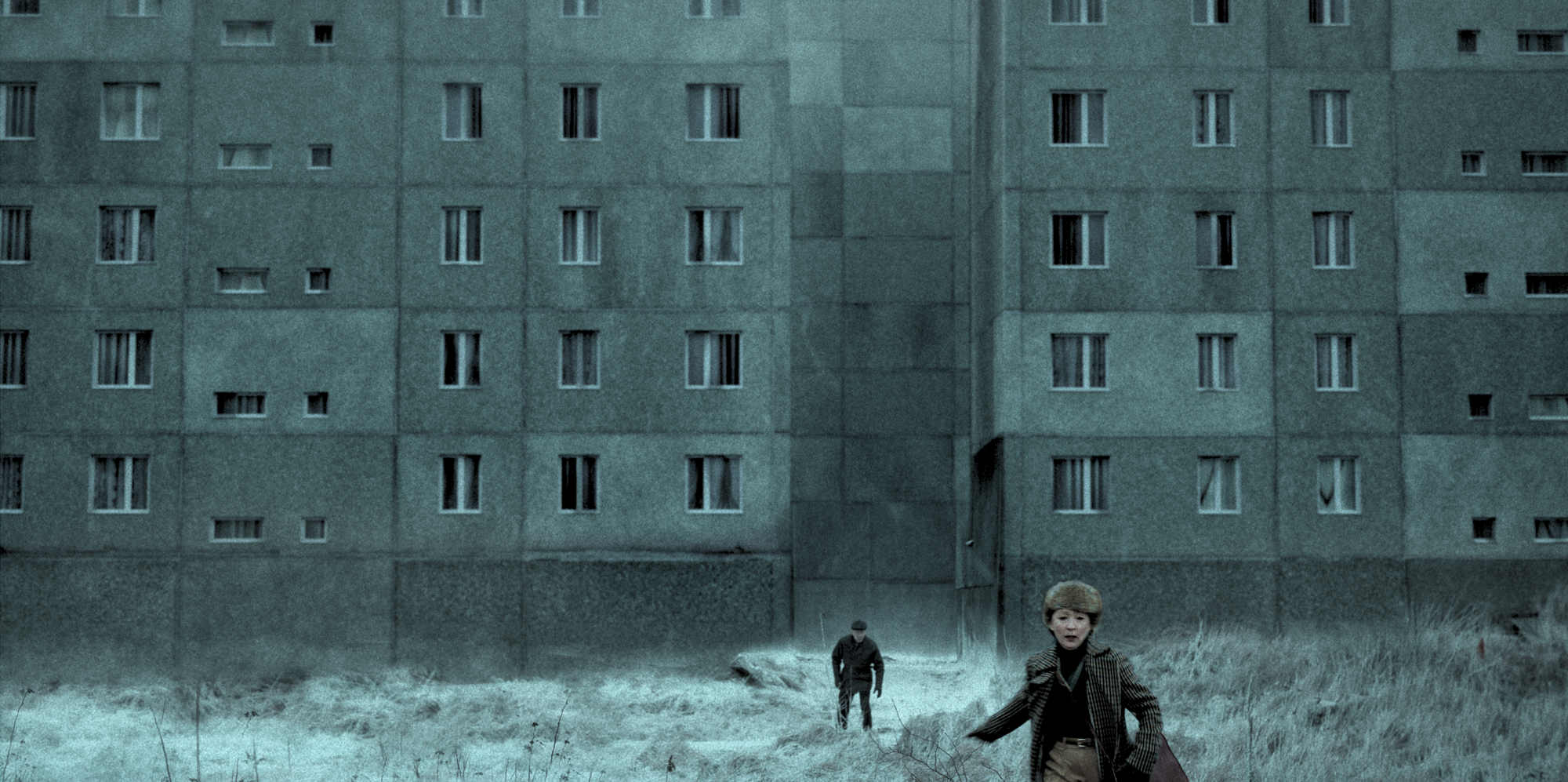
As the third instalment in Singaporean director Anthony Chen’s “Growing Up Trilogy,” We Are All Strangers arrives with considerable prestige. It opened the 50th Hong Kong International Film Festival and marks its Asian premiere following its selection in competition at the Berlin International Film Festival—the first Singaporean film to vie for the Golden Bear.
Spoilers Included
The film reunites Chen with long-time collaborators Yeo Yann Yann and Koh Jia Ler, the latter now 25, having grown from the 11-year-old boy audiences first met in Ilo Ilo (2013).
The narrative follows Boon Kiat (Andi Lim), a Hokkien noodle stall owner, and his son Junyang (Koh Jia Ler), who is on the verge of completing his military service. Their lives unfold through parallel romantic arcs: Junyang’s impulsive relationship with his 19-year-old girlfriend Lydia (Regene Lim), whom he gets pregnant, and Boon Kiat’s hesitant confession of affection to Bee Hwa (Yeo Yann Yann), a beer lady working alongside him.
Two weddings anchor the story. Lydia’s devout Christian mother Tracy insists on a proper ceremony, placing financial strain on Junyang’s family. Afterward, the newly formed households are forced into a government-assisted flat, where mounting debts, unstable employment, and illness steadily erode their fragile stability.
Tragedy arrives relentlessly: Boon Kiat is diagnosed with pancreatic cancer, debt collectors loom, and Junyang struggles to hold down work. Through this, Chen turns his lens toward Singapore’s underclass, exposing a stark counterpoint to the nation’s polished global image of prosperity and order.
Chen’s “Growing Up Trilogy” traces not only a boy’s life but also Singapore’s socio-economic evolution. In Ilo Ilo, set during the Asian Financial Crisis in 1997, Koh Jia Ler plays Jiale, a child forming a tender bond with his Filipino nanny (Angeli Bayani). In Wet Season (2019), he reappears as a teenager entangled in a morally fraught relationship with his teacher (Yeo Yann Yann).
Now, in We Are All Strangers, Junyang is a young father—thrust prematurely into adulthood. News broadcasts and media fragments subtly situate each film in time; here, the family watches celebrations marking Singapore’s 90th anniversary in 2025. Chen has described this life trajectory as a metaphor for the nation itself, suggesting that beneath its development lies a widening class divide that threatens social cohesion.
Another notable thread is the role of technology in contemporary life. Junyang is constantly scrolling through TikTok—a gesture of distraction, impatience, and quiet disengagement. He briefly works as a delivery rider for Grab, reflecting the rise of gig work in the post-pandemic economy.
Bee Hwa, meanwhile, turns to livestreaming, sharing her story as a Malaysian immigrant who has spent three decades in Singapore. Her attempt to monetise this platform—alongside the illegal sale of cheaper medicines sourced across the border—ultimately leads to her downfall. Technology, rather than offering escape, deepens the family’s precarity, exposing how ignorance and desperation can turn opportunity into ruin.
Chen has long been drawn to the idea of “constructed families”—relationships shaped not by blood, but by circumstance and choice. This tension is embedded in the film’s bilingual titles: the English We Are All Strangers stands in deliberate contrast to the Chinese 我们不是陌生人 (“We Are Not Strangers”). The contradiction points to the fragile, often uneasy process through which strangers come to form bonds of kinship. This is most evident when Bee Hwa turns herself in, insisting that Junyang bears no responsibility for the crime. What begins as a strained, almost adversarial step-relationship gradually softens, evolving into genuine care and tenderness.
Yet despite its thematic ambition, the film struggles to cohere. Structurally, it often feels like a three-episode streaming drama rather than a tightly constructed feature. Narrative threads are introduced with promise but left unresolved. Lydia’s religious upbringing and her mother’s strong presence, for instance, are abruptly abandoned after the child’s baptism, undermining emotional credibility.
Similarly, the film’s latter half shifts focus to Bee Hwa’s livestreaming arc, creating the sense of a new chapter rather than a continuation. Compared to the visual and symbolic richness of Wet Season—where, for example, a marching band disrupts a moment of forbidden intimacy at school—this film feels visually muted. Across its 157-minute runtime, moments of cinematic spark are surprisingly scarce.
Following the lukewarm reception of The Breaking Ice (2023), Chen’s first mainland Chinese production, this film marks a return to his familiar Singaporean setting. Yet the response remains mixed. On Douban—often considered China’s equivalent to IMDb—the film holds a modest 5.5/10 based on reactions from Berlinale audiences, suggesting that even this homecoming has struggled to fully resonate.
We Are All Strangers is thematically rich and socially observant, but ultimately uneven. Its ambition to map personal lives onto national identity is compelling, yet its execution lacks the structural discipline and visual vitality that defined Chen’s earlier work. The result is a film that is thoughtful but frustrating—one that reaches for emotional depth but rarely achieves it.
Production company: Giraffe Pictures
International sales: Paradise City Sales, sales@paradisecity-films.com
Producer: Anthony Chen
Cinematography: Teoh Gay Hian
Production design: Huang Mei-Ching
Editing: Hoping Chen
Music: Kin Leonn, Thomas Foguenne
Main cast: Yeo Yann Yann, Koh Jia Ler, Andi Lim, Regene Lim