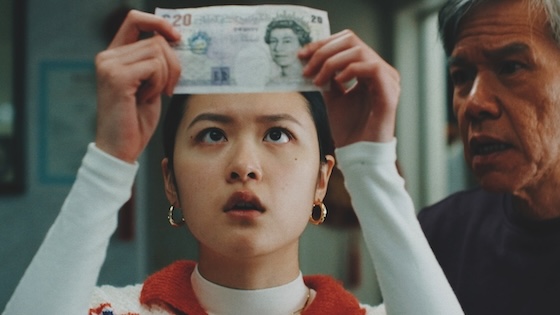
Premiered at the 79th edition of the Cannes Film Festival in May 2026, in the section La Cinef, Will It Rain Again Today is Wong Chau-Hong’s exploration of the status of immigrants living in Japan. Inspired by his own experiences, the short captures a delicate undercurrent of emotional intimacy, intertwined with moments of awkward and understated humour.

Interviewed by Selena Wang, Lou Cai
Why did you decide to move to Japan to study filmmaking?
I first came to Japan in 2023, so it’s been almost four years. I only enrolled in film school last year after spending two years at a language school. As for why I moved from China, it was mainly because many small inconveniences in everyday life gradually added up. I chose Japan simply because it was the most practical option. The cost of living and tuition are relatively low, and the immigration process is comparatively straightforward. I wouldn’t say I specifically chose Japan. It was simply a place that could offer the peaceful life I was looking for. I genuinely enjoy Japan, but my decision was also driven by practical considerations.
What is the inspiration of this short film?
When I first got to Japan, I worked part-time at a courier company while studying Japanese. Our job was mainly to unload parcels from delivery trucks, sort them, and load them onto different delivery vans for distribution. I’d have language classes in the afternoons, work in the evenings because night shifts paid higher, and sleep in the mornings. I like how the mechanical, repetitive work cleared my head, and the pay wasn’t bad.
The best part of the job is I get to talk with other workers during the one-hour breaks. They came from different countries—Vietnam, Bangladesh, Sri Lanka, Pakistan, Nepal. None of us were good at Japanese and our English was worse, so we could only use our broken English and Japanese to talk about food, football, daily life, and why we came to Japan.
Some of them were Muslims. They came to Japan only for the money, but not to settle long-term. One young man I knew from Sri Lanka was only twenty-one, and he’d signed a ten-year contract with the company so he could have enough money to open a small shop back home.
I started thinking about how although their manual labour held up Japanese society, you’d never see them on the streets in the day. Instead, you’d have to look in remote suburban factories in the dead of night. But the parcels you receive every day may have passed through their hands. It’s like they’re living on the other side of Tokyo.
In the past few years, Japan and a lot of European countries have seen a shift to the right. Many young Japanese people are blaming economic and financial problems on foreigners and tourism. But rationally speaking, Japan has a dwindling population, and not many young Japanese people are willing to take jobs like moving goods and handling crates. And immigrant workers can help with these problems. I wrote this story back then, based on my work experience, the friends I made, and my impressions of the immigrant issue in Japan.
Do you think watching your film could help change audiences’ perceptions of immigrant workers?
It’s hard to change people’s minds, but I hope the film can at least loosen some of their preconceived views about immigrants. Many Japanese people have little or no contact with them. At the very least, I hope the film shows that people like this live among us. They are real human beings, each with their own endearing qualities.
This project has a very multicultural cast. How do you arrange the casting?
When I started casting, I was still new to Japan, so I was asking my classmates at my language school. I asked friends to put the word out for the casting. After I ran out of friends to ask, I looked for my friends’ friends, and my friends’ friends’ friends. Basically, I used every connection I could find. Apart from the few Japanese actors, everyone in the cast came through those personal networks, and I could only afford to pay them a small amount.
It actually worked out well because there wasn’t much dialogue, so the roles weren’t especially demanding. And I really like that kind of understated performance anyway. I didn’t want the acting to be too expressive.
I really like the last scene. After the main character’s phone alarm goes off, the film ends just as he is about to leave. Why do you choose to end the story at that incomplete moment?
These days, I’ve been thinking a lot about the word “moment”. After I started film school, I gradually lost touch with the people I used to work with at the courier company. We were all just passing through each other’s lives. With some people, because of cultural, linguistic, or religious differences, you’re naturally less likely to build a deep, lasting relationship. We may never be meant to stay in each other’s lives, but we still share a moment. It could be a few hours or a few days when we have a sincere conversation, share a meal, or simply spend some time together. I think those moments are enough, because some people are only meant to be passing acquaintances.
I think there’s something very sincere about that kind of human connection. Maybe you’ve experienced it yourself. Sometimes there’s something you can’t bring yourself to tell the people closest to you, but then you find yourself opening up to a taxi driver or a complete stranger. Those brief encounters have a beauty of their own.
I’m curious about the film’s musical choices. Why do you choose My Little Airport’s “Charming Scarf” for the end credits? And there’s also a needle drop of Fujii Takashi’s “OH MY JULIET” playing through one character’s headphones. What draw you to that particular song?
I think Oh My Juliet has a very urban vibe, the kind of pop sound that takes me back twenty or twenty-five years, with a rascally, irreverent quality that suits that character perfectly. As for the Charming Scarf, it’s also because I think it fits the vibe. In general, I prefer using pop music because I like the feeling that the characters would actually be listening to those songs.

Are you trying to create a romantic tension between the two protagonists with the ending music scores?
They really are just two people who happen to cross paths. When I was talking to some of my Muslim friends during the writing process, I asked them whether a Muslim could marry someone who isn’t Muslim. They all told me no. So from the very beginning of the story, these two characters were never meant to end up together.
That said, I think it’s only natural that two young people would feel some attraction towards each other while spending time together. For the male protagonist, his motivation of helping this girl may come from some kind of feeling for her. So yes, I wanted to create a slight sense of romantic tension between them. But it’s a kind of romance that is doomed from the start. It carries the feeling of an inevitable farewell from the very beginning, with a quiet sense of melancholy. Both of them have to face the difficulties in their own lives, and at this particular moment, they find themselves standing side by side, confronting the same problem together.
The minimalist visual style of the short is refreshing. It reminds me of Kiyoshi Kurosawa and Ryusuke Hamaguchi, while some of the awkward humour also recalls Wes Anderson. Which filmmakers have influenced you the most?
I was inspired by Hou Hsiao-hsien when I first had the urge to learn filmmaking. I watched one of his films for the first time when I was fifteen or sixteen. I had never seen anyone make films like that before. I really loved the way his work felt both sensible and sentimental at the same time. That’s something I’ve always wanted to pursue in my own work. They’re never overly emotional, but they still feel deeply sincere. There’s a wonderful balance in his films.
Later on, I also became very fond of Jim Jarmusch, Aki Kaurismäki, and Roy Andersson. When I was applying for graduate school, I actually wrote a research proposal about combining the humour of Roy Andersson, Jim Jarmusch, and Aki Kaurismäki with the visual texture of Hou Hsiao-hsien’s cinema. Overall, those directors have had the biggest influence on me.
In a way, I think it also suits the Japanese setting, so these elements came together in a very fortunate way for me: Hou Hsiao-hsien’s visual quality and the cold sense of humour that a lot of people find distinctively ‘Japanese’. The texture of daily life in Japan and the methodical way people have of going about things here give rise to a lot of awkward humour. Not the kind that makes you burst out laughing, but it has an awkward charm. It’s really serendipitous that these directors that I like and this aspect of my experience in Japan converged so well, so I wanted to try it out in the film.
The films selected for this year’s La Cinef had incredibly diverse styles. Is there any that left a particularly strong impression on you? Compared to the films from other countries, do you feel that many of the Chinese shorts selected in recent years tend to be fairly conventional narrative films based on personal experience?
Yes, absolutely. I’m impressed by the selection committee’s ability to choose such diverse films. The one that impressed me the most was a Swiss short called Always Wanted to Be God, Never Wanted to Do Good. I spoke with the director quite a lot, and all I can say is that I really envy his imagination and talent.
It also made me reflect on whether our own films simply aren’t as creative. Personally, I’m not confident enough to do things that I’m unsure about. I don’t really dare to experiment with ideas that are too ambitious or too new. So up to now, all of my shorts have come directly from my own personal experiences.
More generally, I do think Chinese filmmakers may lack imagination and a diversity of perspectives. I really admire many European filmmakers because they have a strong sense of security to allow them to try completely new things. Japanese filmmaking, on the other hand, has become much more homogeneous. Over the past two or three years, a lot of new Japanese films feel like familiar stories that simply repeat themselves. Sometimes, when you attend university screenings, you can even tell which films were taught by the same professor.
Do you have any plans for your next project?
I’m making another short film this year as my graduation project, and it’s set in China because I feel much more connected to and familiar with my home country.
In that sense, leaving China, especially Guangdong, has somewhat narrowed the range of stories I feel I can tell. In China, setting aside questions of creative freedom, everyday life itself offers an incredibly rich and diverse range of experiences and subject matter. Once you move abroad, the kinds of stories you naturally encounter can become more limited, often focusing on experiences such as immigrant communities or studying abroad. These are undoubtedly meaningful and fascinating subjects, but they do not necessarily provide the same breadth of lived experiences and material to draw from.
Can you tell us more?
My next project is based on my experience attending my grandmother’s funeral. The whole process happened in a funeral parlour and felt strangely artificial and uncomfortable. The ceremony was almost like an assembly line: you take a number to wait in the queue, and then the people there will perform the service for you. I understand that they are handling many funerals, but even the photograph of the deceased was just an electronic display. During the service, they played generic “sad” music, and the person conducting it was clearly reciting a memorised script. I found the whole experience quite disrespectful.
In my hometown, the tradition for generations was burial at an auspicious place on the hill behind the village. But now cremation is required, and many people still feel attached to these old practices. I feel that we are gradually losing a sense of beauty and ceremony around death. Some people see these rituals as unnecessary because they have no practical value for the living, but I think that loss is meaningful. I’m still figuring out the story, but I want to keep the same black humour and comedic tone as my previous film.