This interview was conducted in March 2026 by Selena Wang and William Sheppard.
Two young Hong Kongers seeking asylum in Britain find solace in each other as they confront loss, fear, and an uncertain future. With multiple Best Feature awards and sold-out festival screenings, No Time for Goodbye is a powerful debut drama about the fragile hope that blossoms between those who have lost everything … it shines a light on the human cost of exile and the courage it takes to begin again.
—UK-CHINA FILM COLLAB
How long was the film in production for, from start to finish?
Ng: For purely production, we started shooting on July 7th, 2024, so in summer two years ago. It was in NAS (Network Attached Storage) until August 8th, so for around exactly one month.
It took a few days longer than expected, because sometimes you just can’t squeeze things together, but we tried to control it because it’s a very low budget film. Every hour counts. We tried not to shoot the same scene on separate days—we tried to shoot everything and complete it on schedule.
The film’s Chinese and English titles will resonate differently for both Hong Kong viewers and those with personal experiences of migration. What did you hope to express with those titles?
Ng: The Chinese title is from a very famous song by Leslie Cheung in the 1990s. When I was a teenager, that was a song that, you know, it’s on over and over again—風繼續吹 (The Wind Blows On). When I was writing a certain scene of the script, suddenly, this song just pulled up in my mind, singing itself like a soundtrack for the film’s ending. I was so touched—when I tried to imagine the scene with that song, I almost cried. I always cry for certain scenes I’m writing. I make myself believe in what’s been written for that character. So that’s why I thought, oh, that will be the title of the film.
But the problem was, I didn’t have the money to use the song. The rights have been held by different parties—partly Hong Kong, partly Japan—so it’s really difficult to get the license. Even if I could, it would be millions of dollars, so I gave up. But I still used the title. Because when Hong Kong people see that title, the lyrics tell a similar story of someone leaving a place and missing the people, the things, the places in their home.
But for English, if I directly translated the Chinese title, something like ‘When the Wind Blows’, it doesn’t make any sense. One day, my producer, Carol, came up with ‘No Time For Goodbye’. Because this film is about Hong Kong people leaving their home for another country.
In that situation in 2019, when a lot of people were leaving, including myself, it’s a rush. It’s not a plan, not a schedule, like ‘I will immigrate in five years’, or ‘I will be an immigrant at the age of forty’, or ‘I will immigrate with my ten-year-old child’, something like that. It’s not scheduled. It’s sudden. Suddenly, you make the quick decision to leave Hong Kong for somewhere that you have never been before. That is not an idea that you had in your mind. I had never thought about living in another country in my life, but suddenly, people made the quick decision to leave Hong Kong.
The English title very much fits that situation where you don’t have time to say goodbye to the place you grew up, to friends you have been engaged with for so many years—you just leave. And for my child, he didn’t even have time to say goodbye or hold a farewell party with his classmates. All his classmates just found out he was missing the next day—on Friday, they were playing together in the classroom, but on Monday, he’s in the UK. ‘No Time For Goodbye’ is fitting to situations like that.
Not only in Hong Kong—for many people in other countries, war zones like Afghanistan, like Ukraine, I think they have no time for goodbye when they leave the country. That’s how the English title came up, and I like that.

You can sense that the film draws on lived emotional experiences like the ones you just described. It contains specific and evocative details of the asylum seeking experience—for example, when Bosco is given a Mandarin-speaking interpreter by the Home Office. How much of the film is based on real episodes, and how did you research the experiences of UK asylum seekers?
Ng: I went through extensive research and interviews before writing the script. If I had a problem with a scene, I did more research and talked to people to try to connect with them, to get their stories. So many of the scenes, even some dialogue, are from actual, real-person experiences.
For example, you mentioned the interview when he was encountered by interpreters that do not speak Cantonese. That’s a real case. I was very shocked—how come? The UK is a modern and civilised country which should be very much aware of the situation, but in fact, that wasn’t the case. For the refugee from Afghanistan, I added some of her dialogue with Yasmin on the beach back to the final version of the film, about a mother of identical twins, where one of them died during the journey; that experience of crossing the Channel was a real case as well.
Considering those research interviews, do you think your background in journalism influences your approach to filmmaking? Do you consider them similar projects?
Ng: It’s definitely because of my journalistic background. Doing research and talking to people was my daily job for the past twenty years, when I was fully engaged in journalistic work. So when I’m writing a script, I want to make things authentic and realistic. Even if it’s not a documentary, drama and film are based on real life. I don’t want to make a movie where people will question whether it’s ‘realistic’.
For example, the function of the debit card given to the asylum seekers as part of the monitoring system of the Home Office is from a real case as well. One of the asylum seekers from Africa told me that he visited his relatives in London and was called by the Home Office to investigate—‘What were you doing in London? Why did you travel from somewhere else to London?’ He filed a complaint about being monitored. Doing this kind of research is a very important part of my scriptwriting.

The film focuses on the Hong Kongers Bosco and Yasmin, but it discusses asylum and displacement on an international scale. By representing the lens of Hong Kong asylum seekers, how do you hope to impact viewers’ perception of displacement in general?
Ng: First of all, why did I focus on two Hong Kong asylum seekers? They are a very small group of people. We are talking about less than one thousand people in that situation from Hong Kong, a very small part of the community.
But they are very symbolic. They represent a very special time when Hong Kong changed so much. You know, Hong Kong is a modern international financial center, one of the most free cities in the world. And suddenly, why? Why does this city have asylum seekers sitting alongside African people, Syrian people, people from Afghanistan and Ukraine? That is very symbolic to me, and that also means a lot to the world, when one of the freest cities in the world suddenly exports asylum seekers, even if that number is not massive.
As a director, for a debut feature, I think this is a very important story to make into a film, for it to stay in history forever. So that ten, twenty years, fifty years later, when people watch this film, they know there is a story about this happening in 2019. That’s why I focused on this small group—it’s very symbolic.
And there are characters from other international communities. I also want their experiences to resonate with us. Even if we are not asylum seekers or refugees, by sharing their experience in a cinematic way, we think about our own situation. Life, freedom—what does freedom mean to us? What does freedom to work mean to us? What about freedom of finance? These asylum seekers are not allowed to work. While they have freedom of movement and certain freedoms back, when they arrive in the UK, they lose the freedom to work, the freedom of finance. That will make people think about their own situations.
Yasmin and Bosco have strikingly different living situations, with Yasmin in a canal boat and Bosco in a former military building. Why did you choose these two different living environments?
Ng: I didn’t want to stereotype asylum seekers’ living conditions. Many people actually questioned me—‘the refugee hotel isn’t that bad, it just looks like a normal hotel. Why are there no drugs, no fights, no gangsters? Why can Yasmin, an asylum seeker, live in such a nice houseboat?’
I wanted to focus on their search for freedom, their struggles in life, in living, rather than drugs, gangs, you know, these very stereotyped scenes. That doesn’t mean that there’s no such thing. I just didn’t want to include them in the film or make it a gangster movie.
For Yasmin, first of all, when I first came to the UK and saw these houseboats, I felt they were amazing—these houses with people living along the river, travelling along the canals, not staying in the same place, it’s so nice! Sometimes we make a film because we like a scene or a place or even a person, so you can put them in a movie to share it with the audience. I wanted to make it into a film, so I put Yasmin in a houseboat.
Secondly, the houseboat’s owner is an English lady, an artist, who gives this houseboat to Yasmin for free. While the film has far right activists who try to storm the asylum seekers, I want people to see there are very good English people, local people, that really help these asylum seekers. I tried to balance things.

Is that why you chose to follow two protagonists, to create that balance?
Ng: Yes. I intentionally created one male and one female character so they could have some conflict of choices when they somehow find a relationship evolving. In the end, their relationship goes nowhere, because Yasmin has a boyfriend in jail in Hong Kong.
That will be a situation shared by some Hong Kong people. Even with their freedom here, they still have something that cannot be cut off with Hong Kong. Not necessarily a boyfriend or girlfriend in jail, but something. So they are not totally free when they’re in the UK—they still have something they can’t cut off.
Yasmin’s boyfriend is symbolic of this something. In the end, when Bosco tries to go further with the relationship, Yasmin realises that she can’t cut off her boyfriend. Even if she wants to be with Bosco, that tie is so strong that she can’t just cut it off. And then she realises, what’s the purpose of seeking freedom in the UK? The purpose of being in the UK is not to find another boyfriend. So the conflict is here. For Bosco, he wants a new life. He really wants a brand new life, but he can’t.
We see small snippets of their previous lives, but the film focuses on Yasmin and Bosco’s present situations rather than their past and future. Why did you choose not to reveal their pasts?
I struggled with this a lot. I gave hints, rather than details, about what happened to them in Hong Kong, what made them escape. I struggled a lot about whether I should give a complete flashback. In the end, I chose to give hints, because I want Hong Kong audiences, and foreign audiences, to imagine what happened to them in Hong Kong, what made them leave.
For Hong Kong audiences especially, I want them to apply themselves. If I leave more blanks, then more Hong Kong people can put themselves in that situation—everyone will have their own imagination of what’s going on.
Because in 2019, at the peak, three million Hong Kong people took to the street. That means almost all Hong Kong people participated in the situation. When they watch the film, they will have their own reflection into it, into their past. I don’t need to write it. They will. They will fill in the blanks by themselves.
For the final version, I added a little bit more to the film. When Yasmin is interviewed by the Home Office, she gets a quick flashback when the interviewer mentions her boyfriend, to the day her boyfriend got arrested. I added that back after some struggle, and I think this is much better, to have at least some visual flashback during the interview.
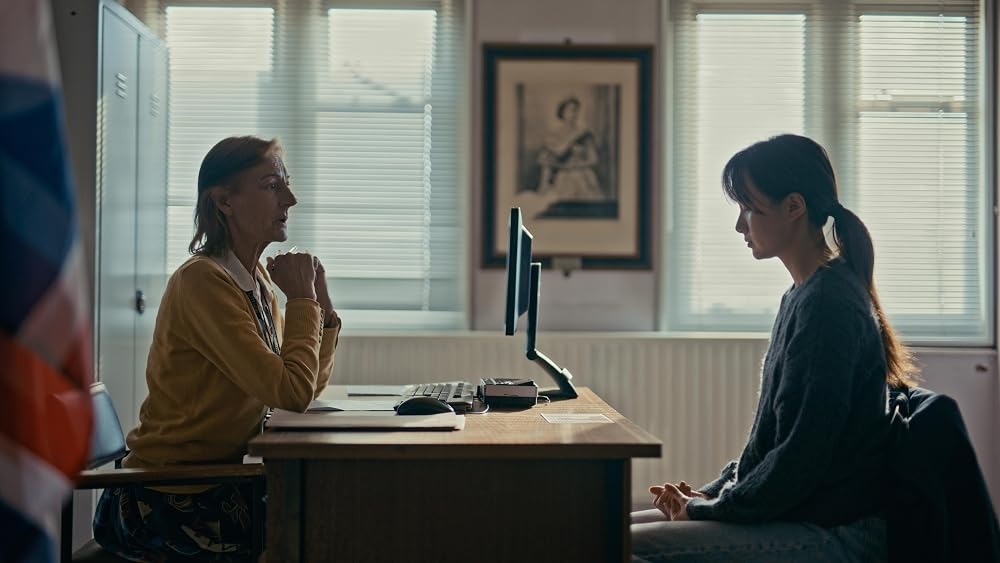
You’ve spoken about how Bosco’s Actor, Sing Lam (林耀聲), filmed right after a 26-hour flight to stay in character, and the performances of the far-right activists are quite intense. What was your casting process, and how did you work with the actors to bring out the emotions of a refugee story?
Ng: That was very hard work. Maybe you would imagine I have a huge team of casting directors or producers working on casting and auditions, but this was an independent film. I found the actors one by one, by myself. I have done twelve short films before and deliberately produced six short films after I arrived in the UK, to work with local talent in preparation for my feature film. I tried to understand them, know them, and network with them.
When I was casting for this film in 2023, some of them were actors I had collaborated with in my short films who I thought were very good. One of the far-right activists—he’s from Scotland—has been in two of my short films. Even for smaller supporting roles, like the Home Office Border Force, I used an actor who has been in my short films.
For the other actors, there were eighty of them, a huge number for me to handle. For the large part, I found them on independent actors websites. I use Mandy.com, because there are so many independent talents, and I don’t need to go through their agents—for an independent film, I want to talk directly to the actor. I searched, contacted them, and asked them to send me self-tapes, one by one. Sometimes I give them a different role, when I find their texture, and think oh, she’s good for that character. I love talking to them and finding the best place for them in the film.
The most difficult part was finding an actor from Afghanistan for Amina, Yasmin’s friend. When I searched for an Afghan actor on Mandy.com, most of them turned out to be Indian actors based in the UK. I think Yasmin’s friend is a very important character, and I needed someone very good. Finally, I reached more Afghan actors through Google, and then I found Hashiba. Hashiba is an Afghan refugee living in Australia. I researched her background—she was beautiful, and 100% fit to Amina. I contacted her, and she was happy to do the job.
So it was a very extensive process. They are very good. Even for supporting actors, some of them are actually very well established in British films, even in BBC movies, but they were still happy to do such small supporting roles in my film. They are not nobody—they are somebody in the industry, but they were still happy to work in my film, so I’m very grateful to them.

The film’s dialogue is very multilingual. Was this shaped collaboratively with the actors?
Ng: Definitely. The scripted dialogue just gives a basic situation—on set, I let them express themselves in their own way. For example, Hashiba is a very good actor. She started acting at the age of nine or ten in Afghanistan; she’s very well established in stage dramas and very good with dialogue, so I requested her to change the dialogue if she wants. The reunion scene with Amina’s younger sister outside the Home Office was not scripted. Hashiba just performed, and Yasmin’s actress, Kitty Yu (余子穎), was so, so good in responding. She just knew what she was going to say.
In that scene, Hashiba uses an Afghan dialect, not English. When I was listening through the monitor, I didn’t know what she was saying, but I trusted her. I knew she must be saying something meaningful, and her expression, everything, was so authentic, like she was really reuniting with her younger sister. Afterwards, I asked her to translate for me, and it was so good. There was no script: Yasmin asks, “does she speak English?”, and Hashiba responds, “no, she doesn’t”. At that point, I thought it was done, but she adds—“she will soon”. It’s so touching, so authentic, just a live performance by these three characters. She doesn’t know that Yasmin will ask her that, and Yasmin could just stand there, but she speaks as well. I think it was much, much better than what I had written. I’m still touched by it.
We’ve spoken a lot about migration throughout this interview. How do you see the importance of the film to the wider contemporary public understanding of migration and asylum?
Ng: By sharing these asylum seeker’s stories, where most of them draw from real people’s experiences, I really hope that people will, like we said, be touched, by even one sentence of dialogue, by one small scene, or one little tear. Then they will have more understanding of what happens to them as people, not just as a label. ‘Asylum seeker’, most of the time, is a label in news reporting. But I tried to show them alive, as people, in front of the audience.
Don Ng Hiu-tung (吳曉東) worked as a senior journalist in Hong Kong for decades before relocating to the UK in 2019, where he has transitioned to filmmaking to continue telling the stories that need to be told.
No Time For Goodbye is touring in cinemas across the UK until July 29th — Tickets here