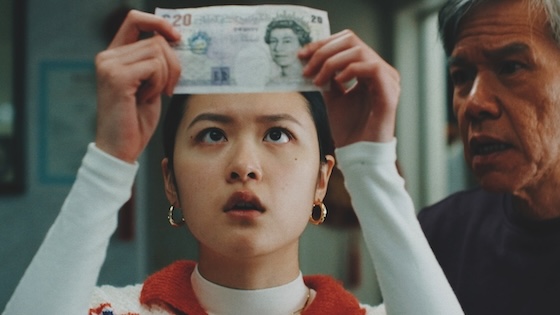
Premiered at the BFI London Film Festival in 2025, High Wire is the striking debut feature from Hong Kong-born, UK-based director Calif Chong.
Blending humour, emotion, and social realism, the film follows a young British-Chinese woman whose life working in her family’s takeaway is transformed when a travelling circus arrives in her rural town, opening the possibility of freedom, identity, and self-discovery.
Following its festival debut and growing critical attention, we spoke with Chong about representation, immigrant identity, and bringing a distinctly British-Chinese story to the screen.
We have conducted an interview with Chong to find out more about her creative vision.
Senthoran: Can you outline your journey from a film student to debuting a feature film?
Calif: I completed my bachelors in Chinese Language and Literature at the University of Hong Kong in 2012, with the aim of becoming a teacher. After then, I became a scriptwriter for terrestrial TV network TvB. Those raised around that part of the world will recognise the network for their output in the late 90s and 2000s. I worked there for 2 years, and then moved to Hoy TV, where I worked as a development producer for documentaries.
I was accepted at London Film School in 2016 and have been here (U.K.), for 10 years now.
Senthoran: How did you secure funding for your feature film?
Calif: Funding in the U.K. was mainly from institutions supporting independent cinema such as the BFI or the BBC. My producer was instrumental in securing funding from other direct investor channels to make this film happen.
Senthoran: Typically diaspora stories tend to be set in urban areas, surrounded by the community. High Wire, on the other hand’, isolates the diaspore experience in an unconventionally rural setting when compared to a film such as Po-Chih Leong’s Ping Pong (set in the bustling London Chinatown)?
Calif: I think a sense of isolation was important to convey in this film. Practically, I wanted a space where I would be able to set up the circus. We had six trailers worth of equipment to lay out the structure of the circus, and so we would need a huge space – which is not quite tenable in London. So my Yorkshire based producer, Tippy Watson, had worked with this specific circus before for a ‘The Real Greatest Showman’ series on Amazon.
She had access to piece of land behind her home in North Yorkshire, and asked whether we had wanted to explore the region there. Prior to that, I had looked at towns in London and Milton Keynes to set the story. Milton Keynes especially, due to a large Hong Kong diaspora and it’s reputation as being home to various international communities.
I had read a book called ‘Takeaway: Stories from a Childhood Behind the Counter’ by Angela Hui, and it opened my eyes to her experience of being Chinese in a remote village, working in a takeaway. That sense of ‘otherness’ was so apparent by the cultural differences and events in that book.
Senthoran: In the canon of British film, this joins the tradition of films such as ‘Bend it Like Beckham’, using sport as a form of escape from community restrictions. As a narrative, this aligns with the universal underdog story, with clear stakes. What led to the focus on ice skating, in this context?
Calif: Haha, thank you for that question. I love ice-skating, and I wish I had the talent to have persued the art. We were obsessed with Kristy Yamaguchi’s ice-skating videos growing up. She was the first Asian-American woman to win the Olympics, and this was in the era of Tonya Harding. When I had the chance to make ‘High Wire’, I made sure Go-Wing had that inspiration from her mother.
Her mother’s ambitions were unfulfilled due to circumstance, as it is the case for so many people who had to immigrate for a better life and make sacrifices. The pursuit of Art was not really a working-class goal, it was an eccentric activity when you don’t have the comfort of wealth. Go-Wing embracing art is reflects a breaking of this generational chain that weighs her down. And that means a lot to me as a filmmaker. Though it was very difficult to get all that iceskating on the screen with our budget!
Senthoran: In addition to sport, you also use the circus, as a form of escapism, which adds a surrealist dimension to Go-Wing’s journey. Can you outline your introduction with the circus performers? Also, could you comment on the intention behind the performers being from minority-backgrounds?
Calif: I am incredibly grateful for an opportunity to work with a circus. My producer Djonny Chen had a relationship with the circus, and had known Tippy from beforehand. Djonny was the one to approach me to create a film centred on the British-Chinese community, and I jumped at the opportunity.
I saw the circus perform as part of background research to see how I could incorporate them into my narrative, and was blown away by their art. This troupe was composed of winners of the Monte-Carlos Circus Festival, so this was really the pinnacle of the form.
They were very excited to for the film, and had struggle with all the waiting around on set. We had performers from Venezuela, Ukraine, Brazil and all over the world, to risk their life for something so abstract. I have never liked the cliche of ‘running away with the circus’, but I tried my best to not use it as a cop-out and weave it into the story in a modern setting.
Senthoran: The setting of the film becomes increasingly important throughout the film. It leads to an event, which may have been seen as a shock, or an inevitability depending on the audience. It is an incident led by hatred and bigotry. Is this something you wanted to include in the story from inception, or was this inspired by contemporary events?
Calif: The vandalism was written into the story from the first draft of the story and showed it to my co-writer Jackie Lam, who also happens to play Eddie in the film. He grew up and worked as a takeaway restaurant worker in Huddersfield, in North Yorkshire, and insisted on reflecting the experience of the first-generation immigrants who frequently endured vandals in that time. This was heightened in rural areas, who were not exposed to other cultures, and would engage in hooliganism mostly out of boredom, and sometime from a place of hate, on ‘easy-targets’.
At the time of filming, I was unsure whether this was an occurrence that was relevant in the current day. Whilst shooting, the people in the village were concerned and rushed over to offer help, and I was telling them there was nothing to worry about and that this was part of filming. During a test screening of the film, some of the feedback was enquiring whether racially induced vandalism was still a problem worth attention, and this had me considering whether I was depicting something that was not reflective of the real situation. In fact, one week later, there were far-right protests and, my friends and I had to cancel out meet-ups out of worry. That made me reflect a lot on the severity of situation.
I did not grow up in the U.K., so experiencing some of these events were a shock to me. I’ve been living in London for 10 years, and I’ve encountered a lot of these acts of racial violence, and especially so since the Covid-19 I can only imagine how bad it is for minorities in villages, when the big cities are often heralded as the places of inclusivity.
Senthoran: For those that say these events do not happen anymore, they fail to understand that for several communities, reporting to authorities is not culturally accepted, and so the numbers would not reflect the reality of the situation. I find it interesting that whilst the film is focused on the story of a second-generation immigrant, your personal journey more resembles that of the first-generation. You have been sympathetic with your portrait of the struggles of the first-generation which is suprisingly rare. What were the considerations when representing the now-looking-back older generations?
Calif: I am thirty-something now, and, perhaps if I was making the film in my twenties, I would have had a more cynical outlook. I felt like a small fish in a big pong in Hong Kong, where everyone else seemed so wealthy in comparison. I made the decision to migrate to the U.K., and I read and experienced the struggles of those who embarked on the same journey. I really empathise with them, and wanted to be kind to the dad character. Perhaps, it was the education that I had received, which gave me the patience and knowledge to be successful in this. When the two generations watch the film, I want them to talk to each other. So, I was quite persistent of keeping the ending as is to allow for this.
Senthoran: Go-Wing’s cousin, Eddie, is a successful lawyer who also happens to be gay. This is a source of tension during family gathering scenes. What were your considerations when portraying a gay person, especially in a community where it may not be traditionally accepted to be openly gay?
Calif: I wrote that character to actively defy stereotypes against the portrayal of Chinese men in their 20s and 30s, as nerdy and incapable of expressing themselves. I want my characters to have secrets. Because I’m working with a hundred minutes to convey a series of connections, it’s difficult to focus on everyone’s story with equal depth. Complicity through shared secrets, is an effective and quick way to establish these character relationships.
I had the Aunt Lee character in my head early on. A lot of my gay friends with Chinese heritage struggle to come out to their parents, and I really empathise with them. I wanted to write a successful, gay Chinese man. Him being a lawyer, is also a reflection of Go Wing’s alternate life path, perusing a professional career.
Also, I’m a huge fan of Ang Lee’s ‘Wedding Banquet’. It was one of the first films I saw which addressed gay expat workers in a lighthearted yet poignant manner. So, in a way, very much a tribute to the great director.
Senthoran: There is an incredible scene at a dinner table, where you turn up the pressure in the room, and showcase a rapid fire exchange of puns and insults — notably mentioning the late great Leslie Cheung. Can you go through what you had in mind when crafting this?
Calif: So much tension in that room! I love food, and I love the tradition of hotpot, so this was both an exercise of excess and restraint for me, haha. One of my favourite films is, ‘Eat, Drink, Man, Woman’ (Ang Lee), so may be a subconscious reference to the portrayal of food as a form of familial communication and reconciliation. I wanted to contrast that warm feeling associated with hotpot, with the dark undertones of the bigotry in the conversation. These arguments are unfortunately still ongoing within and between generations. I didn’t want to interfere too much and come across as didactic, but definitely intended to show that the younger generation rejects the antagonisation of homosexuality. I also thought in the heat of the exchange, it was important that Go Weng stands up for her mother’s pursuit of artistic achievement, in the face of those undermining this as an unprofitable venture.
Senthoran: It may be early to ask this as High Wire has opened at BFI to great reception, but what do you see yourself tackling in your filmmaking looking ahead.
Calif: I want to tell female stories from an East Asian perspective. In English-language cinema, this hasn’t been explored enough. I want to explore different genres and not be pigeonholed to make one type of feature. High wire was a coming of age film with elements of both the tragic and the comic. I think black comedy is a style I want to explore further.
Senthoran: The letterboxd top 4 has been a popular question. Consider this a practice run, what’s in your tiles?
Calif: Ohhhh, so firstly, Zhang Yimou’s Raise the Red Lantern. I read the novel, and I actually think the film is a far better in conveying the atmosphere. Edward Yang’s Yi Yi, of course — so poetic.
Parasite (Bong Joon-Ho), whenever I watch it, I think this is why I want to make films. Finally, Martin Mcdonagh’s In Bruges: so dark, so funny. Really it’s so human, filled with empathy.
Senthoran: Could you share any advice you would have for filmmakers from a background where they may not have institutional or family support?
Calif: If only it was as simple as don’t give up! I would say if you really want to make film, don’t doubt yourself. Don’t let people, even people you love, introduce doubt. There will be people who question whether you have enough passion, or if it’s financially worthwhile, but you have to be deaf to the wrong noise and ears open to the right voices.
Just try to survive till you can make a film, of course! I still think there’s enough support and creative schemes in the UK, where you can make a career, not only as a writer or director, but as someone working along the process of filmmaking.