
Tan Chui Mui courtesy Nowness
On Weibo, Tan Chui Mui had an account called “Tan Chui Mui’s Micro Fictions.” Before 2013, she would update every few days with a short fiction piece within 140 characters. Much like someone sticking to a daily exercise routine, writing these short fictions became a personal challenge and a habit she had to maintain. No matter how good or bad the story was, she had to post it before midnight.
Over time, however, the habit gradually faded. “Writing stories became too formulaic, too easy—I could finish one in just ten minutes,” she said. Instead, she turned her energy to Brazilian Jiu-Jitsu, which then became the habit she committed to every day.
But outside of Weibo, Tan never stopped writing and telling stories.
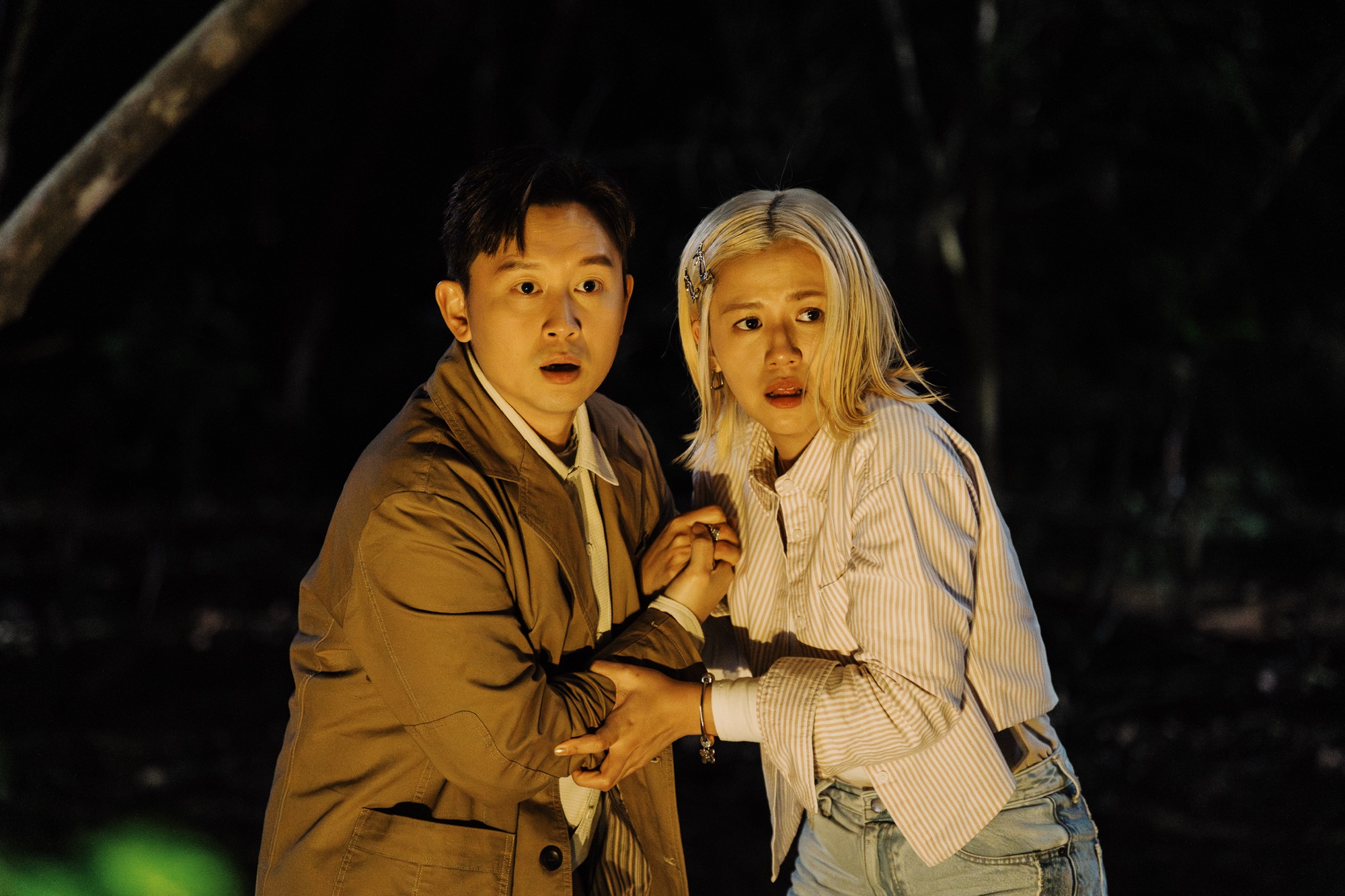
From her early experimental shorts to her more recent feature film Barbarian Invasion, she has continued to create with freedom and playfulness, constantly exploring new ways of storytelling—through different forms, languages, and genres.
Lou: Many of the stories in your films seem to come from your personal experiences. Where do you usually find inspiration for your work?
Tan:
I developed the habit of writing since I was young. I used to carry a small notebook in my pocket and write down all my thoughts. That kind of writing feels no different from my later filmmaking—it’s simply my ideas extending into imaginary scenes, not always drawn from real experiences.
Instead of having inspiration, my work comes from feelings. Sometimes I’m just moved by something and want to record or express it. When I was younger, I had lots of ideas, but as I grew older, I had fewer impulses or inspirations, so I wrote and created less.
Even if the experiences aren’t real, many of my emotions are. They’re often sparked by something that affects me deeply, or a kind of anxiety I feel compelled to share.
Lou: How is making short films different from making features? Do you prefer one over the other?
Tan:
My short films usually had no commercial goals, there was no commercial investment involved. They were made with friends over a weekend on a budget of just a few thousand ringgit—completely free, with no pressure. But with features, that freedom won’t be possible to achieve.
Features are seen as more “serious,” requiring bigger budgets and stricter structures. Once a film is longer than 20 minutes, it can’t be played like a short—it can’t be too experimental or disregard the audience entirely. I want my features to still be accessible to the mass audience.
Tan:
I definitely prefer shorts. I love making shorts. Making features feels like something you have to do so I did. My first feature came about because people didn’t take me seriously when I only made shorts. But even after that, I went back to shorts, because I feel they hold more possibilities—like writing small stories on Weibo.
Lou: Besides films, you also love writing. How do you create such natural and witty dialogue in your work?
Tan:
There are two kinds of dialogue in my films. Some come from conversations with myself. In high school, I had friends, but not many who shared my interests, so I’d write my thoughts as a Q&A with myself. My films often begin with a question, then the search for an answer, which leads to more questions—that’s how the dialogue unfolds.
The other kind comes from listening to others. I’ve always loved eavesdropping, and I would remember conversations word for word to write them down later.
Lou: In A Tree in Tanjung Malim, some audience think the dialogue between the two characters was essentially your self-questioning. Was that intentional?

Tan:
Yes, that is correct. At the time, I was 27, so I created a 17-year-old girl about to study in Taiwan—her world full of possibilities—and a 34-year-old man whose beloved had just married, his world seemingly devoid of possibilities. I stood between them. I wasn’t the girl with infinite potential, nor did I want to be the man with none. It was, in a way, the conversation with myself.
Lou: You love weaving folktales into your films? Are they stories you’ve heard or ones you make up?
Tan:
Almost all my films feature some kind of storyteller—sometimes a tale, sometimes just a joke. Some I research to match the theme, others I already know. In A Tree in Tanjung Malim, for example, there’s the panda joke about wanting a colour photo—it reflects the theme of impossible desires.
In Year Without a Summer, I used a Japanese folktale, but the crab-eating-sand story was my own invention. In Barbarian Invasion, the Miyamoto Musashi story came from a Tai Chi–practicing friend, though it was misremembered or invented. For me, stories matter—they convey themes more directly than rational reasoning. We think of stories as for children, but in truth, they subtly transform how people think.

A story is the strongest tool of persuasion.
Lou: Does creating in different languages change your creative process?
Tan:
Yes. I grew up speaking Hokkien, learned Mandarin in primary school, Malay in middle school, and English at university. So each language serves a role: I think about films in English, write philosophy and literature better in Chinese, use Hokkien talking to my family, Cantonese is for jokes or curses.
My scripts are bilingual—some crew don’t understand Chinese, others don’t know English. Sometimes I draft in one language and revise in the other.
Switching languages changes how I think—like water flowing differently down the hill. Translating also sparks new ideas, which helps me improve my scripts.
Lou: Barbarian Invasion is about the journey to self-discovery. Why present this theme with a Kung Fu film?

Tan:
I don’t see it as an action film, but as a philosophical, even Zen film. Martial arts is a direct way to confront fear—our most primal self is revealed in the fear of pain, injury, or death.
When Master Luo hits Lee Yoon Moon and asks, “Who is dodging?”—the dodging self is the truest self: the one that doesn’t want to be hurt or die.
Lou: Have you trained in martial arts before? How did you prepare for the action part in this film?
Tan:
I wanted to reference The Bourne Identity in this film, so I researched Matt Damon’s training routine. He learned Krav Maga and Kali, so I flew to the Philippines for a 15-day crash course in Kali. Since 2019, I’ve trained in Brazilian Jiu-Jitsu, and earlier in Muay Thai and MMA, just for fun. For this film, I only learned Krav Maga and Kali.
Lou: In the film, Master Luo tells the protagonist not to get into fights. Where does that line come about?
Tan:
It’s just a joke. Traditionally, Kung Fu masters like to warn their apprentices not to reveal their skills or fight outside. But immediately, the protagonist does exactly that—like the The Monkey King in Journey to the West, who is rebelling against all the rules.
Lou: Barbarian Invasion is not only an action film but also weaves in romance elements and a film-within-a-film structure. With so many complex layers, how did you approach balancing them?
Tan:
I stuck to the theme of questioning “Who am I?” Every time the protagonist thinks she’s found the answer, it crumbles—like dreams within dreams, plays within plays, echoing Inception. It’s about realizing that certainty is always just out of reach.

Lou: Audiences often see Hou Hsiao-hsien, Edward Yang, or Hong Sang-soo in your films. Did Barbarian Invasion take cues from any directors?
Tan:
Not as an influence but more like a parody—I mimicked The Bourne Identity because its main character wakes up asking “Who am I?” That’s exactly what I try to ask in my film.
But influences are inevitable. Growing up in the ’80s, I watched countless Hong Kong films, no matter good or bad. They aren’t always there as a tribute, but to whatever fits the narrative. They’re not declarations of taste, but functional choices.
For example, I love The Matrix, but the monk’s red-and-blue pill line isn’t a “tribute”—it’s just a tool. I once knew a monk who said The Matrix and Inception were the best films to understand Buddhism. Monks watch films too—it’s natural for them to use cinematic metaphors as well.
In real life, people mention films casually in conversation. But when characters do it in films, critics often over-interpret it as homage. To me, everyone watches films, it’s just a natural thing everyone does.
Lou: Are you working on new projects now? Will you do more action films?
Tan:
I’d love to, but action films are expensive, so I’m still looking for funding.
Lou: Any young Malaysian filmmakers we should pay attention to these years?
Tan:
Yes—Gogularaajan Rajendran, an Indian-Malaysian director. He is making a musical-style documentary on rubber plantation workers. Also Amanda Nell Eu, whose Tiger Stripes screened at Cannes, and Jiang Xiaoxuan’s To Kill a Mongolian Horse, which I produced last year.
There are many promising young filmmakers in Malaysia.
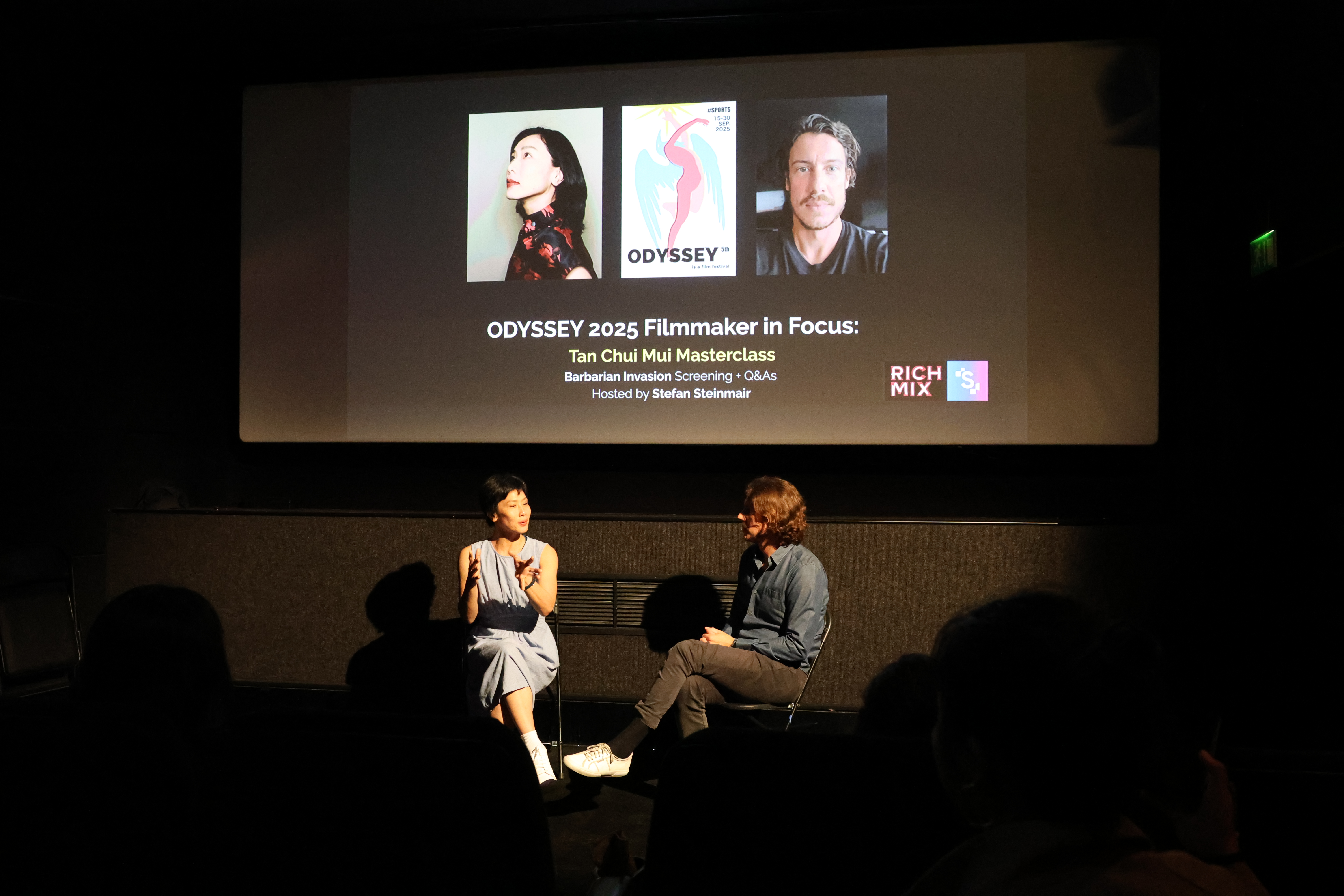
Tan Chui Mui is honoured as the “Filmmaker in Focus” at Odyssey 2025, an annual film festival in the UK. Tan did a Masterclass in person at the Rich Mix in London, after a screening of her award-winning feature Barbarian Invasion (2021).