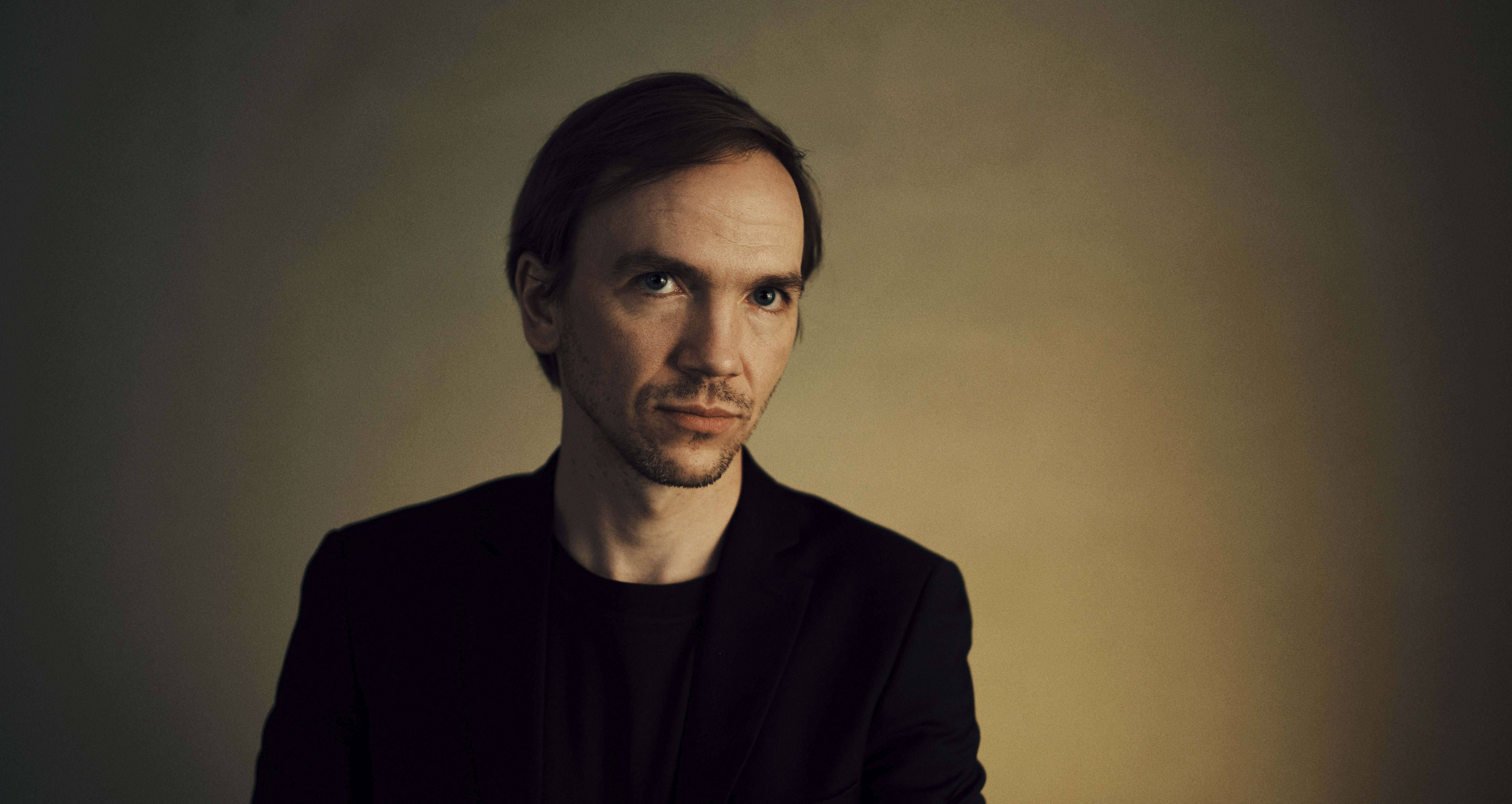
Acclaimed Polish filmmaker Jan Komasa returns with his first English-language black comedy thriller Good Boy (2025). Starring Stephen Graham, Andrea Riseborough, Anson Boon, and Kit Rakusen, the film centres around a dysfunctional family who abduct a 19-year-old criminal and attempt to “rehabilitate” him through increasingly unsettling methods.
Filmed across Yorkshire and Warsaw, Good Boy marks Komasa’s first UK–Polish co-production, situating the project within a broader context of cross-cultural filmmaking and international collaboration.

In our online conversation, Jan reflects on the film’s experimental approach, particularly its engagement with morally ambiguous and provocative subject matter. He discusses how he navigates and balances its shifting tonal registers, while also sharing insights into his experience of working in the UK.
Rino: The notion of a “good boy” in the film seems to carry a distinctly paternal, even patriarchal tone. It suggests that when formal systems of education and social order fail, individuals may attempt to impose their own forms of correction outside legal frameworks. In the film, the couple abducts a boy and enacts what could be seen as a form of vigilante justice. How do you view this approach, and how is it positioned within the narrative?
Jan: From the beginning, this was conceived as a grotesque thought experiment. It was never meant to be realistic. The film operates between two distinct worlds. One is Tommy’s world, where he can do whatever he wants. He lives a chaotic, directionless life shaped by a kind of trash culture, and yet no one intervenes, no one really cares.
The other is the world of Chris and Kathryn. In that space, Tommy is literally chained up like a dog, but at the same time he is given constant care. They are deeply invested in him, almost obsessively so. They provide books, play classical music, and attempt to “educate” him.
The film juxtaposes these two extremes without offering a middle ground. That is where the grotesque element comes in. While the performances are grounded and emotionally authentic, the structure itself is not intended to be realistic.
I am not trying to legitimise Chris’s methods. Rather, I want to provoke the viewer. The film becomes a kind of dialogue between the screen and the viewer’s conscience. Each person has to ask themselves: what are my values, where are my moral boundaries?
The responses vary widely across different countries. The film was well received in the United States, the UK and Poland, but in France it was rejected for being immoral. That range of reactions is part of the point.

Rino: You mentioned this idea of experimentation. It reminded me at times of Funny Games (1997). I’m also curious whether the film reflects your concerns about rising youth violence today.
Jan: As a parent, I do think about these things. But my concern is less about violence itself and more about attention. We are living in a time where attention has become a commodity. For the first time, perhaps, attention is constantly being competed for — by platforms, media, and cultural production. Every moment of the day is fragmented and redistributed across social media, streaming platforms, and digital content.
What captures attention today tends to be extremes: things that are more aggressive, more shocking, more immediate. You start watching something, and then something more intense pulls you away.
In that sense, attention is being extracted almost like a natural resource. Entire business models are built around capturing and exploiting it. I am part of that system as well, since I make films.
This is why I wanted to provoke a discussion — are there other ways of engaging with one another, of caring, of truly seeing and hearing each other? The film exaggerates this through an extreme scenario, forcing someone to pay attention.

Rino: The film seems to oscillate between different tensions: thriller and realism, discipline and reform, freedom and confinement. How did you balance these opposing forces in your writing and direction?
Jan: At its core, the film is driven by Tommy’s attempt to escape. That is the central source of tension. At the same time, I wanted to gradually build a sense of connection between him and the family. This creates a contradiction: the more he becomes part of the family, the more complicated his escape becomes.
That introduces a dramatic layer on top of the thriller structure. On top of that, I added elements of dark humour. So the film operates across three registers: thriller, drama and dark comedy. The key was maintaining balance. I did not want one element to overpower the others.
We approached this very systematically. Together with the writers, Bartek Bartosik and Naqqas Khalid, we mapped out each scene in detail. We even tracked Tommy’s level of emotional engagement with the family as a kind of progression, from total resistance to gradual involvement.
Each character has their own arc within a confined space. As a director, I approached it almost like composing an orchestral score, carefully controlling rhythm, tension and release.
Rino: The house scenes were shot in a studio in Warsaw that previously hosted the Polish version of Big Brother (2001). Was that context important in your choice of location?
Jan: That aspect was more anecdotal than intentional.
We shot in a large television studio complex near Warsaw, known as Sękocin Stary, which became famous during the early days of Big Brother in Poland. At the time, the idea of constant surveillance was fascinating to audiences.
By the time we used it, the space had already been converted into a standard production studio. We built our sets there, including multiple floors and the basement.
Interestingly, the basement we used was in the same building where one of the most infamous moments in Polish television history took place during Big Brother. That detail added a certain layer of dark humour for us during production, but it wasn’t the primary reason for choosing the location.

Rino: Good Boy is a UK co-production and has received support from the UK Global Screen Fund, with parts of the production reportedly taking place in Yorkshire.
What motivated you to pursue a UK co-production? Could you share more about your experience working across these two contexts, particularly in terms of creative development and production logistics?
Jan: Initially, the film was conceived as a Polish story, set in Warsaw, with the main character as a football hooligan. However, I realised that if the film remained in Polish, it would likely be interpreted primarily as a commentary on Polish society. That would limit the scope of the idea, which I saw as more universal. So we decided to move the setting. Through our producer Jerzy Skolimowski, we connected with British producer Jeremy Thomas, who supported relocating the project to the UK.
The script was then adapted by Naqqas Khalid, who brought a strong sense of place, particularly drawing from Manchester. Eventually, production shifted to Yorkshire due to funding opportunities, and we ended up shooting in locations that evoke a kind of Wuthering Heights atmosphere.
Rino: How do you see the future of UK–Poland co-productions? Do you think the UK’s funding structures and production environment will continue to attract Polish filmmakers and encourage further collaboration?
Jan: After all, we are part of the same continent. Brexit made collaboration more difficult for a period of time, particularly in terms of funding and logistics. However, recent changes have made co-productions more accessible again, and I think this will encourage more collaboration between the UK and European countries.
Culturally, Poland and the UK share certain sensibilities, especially a familiarity with moral ambiguity and dark humour. There is also a strong Polish community in the UK, which creates additional connections.
I see this as just the beginning. There is significant potential for future collaboration, and I am very interested in continuing to explore it.
Distributed by Signature Entertainment, Good Boy was released in UK and Irish cinemas on March 20, 2026.
Image credits: Film stills from Good Boy (2025), sourced from IMDb. Images are used for editorial purposes only. Copyright remains with the respective rights holders.