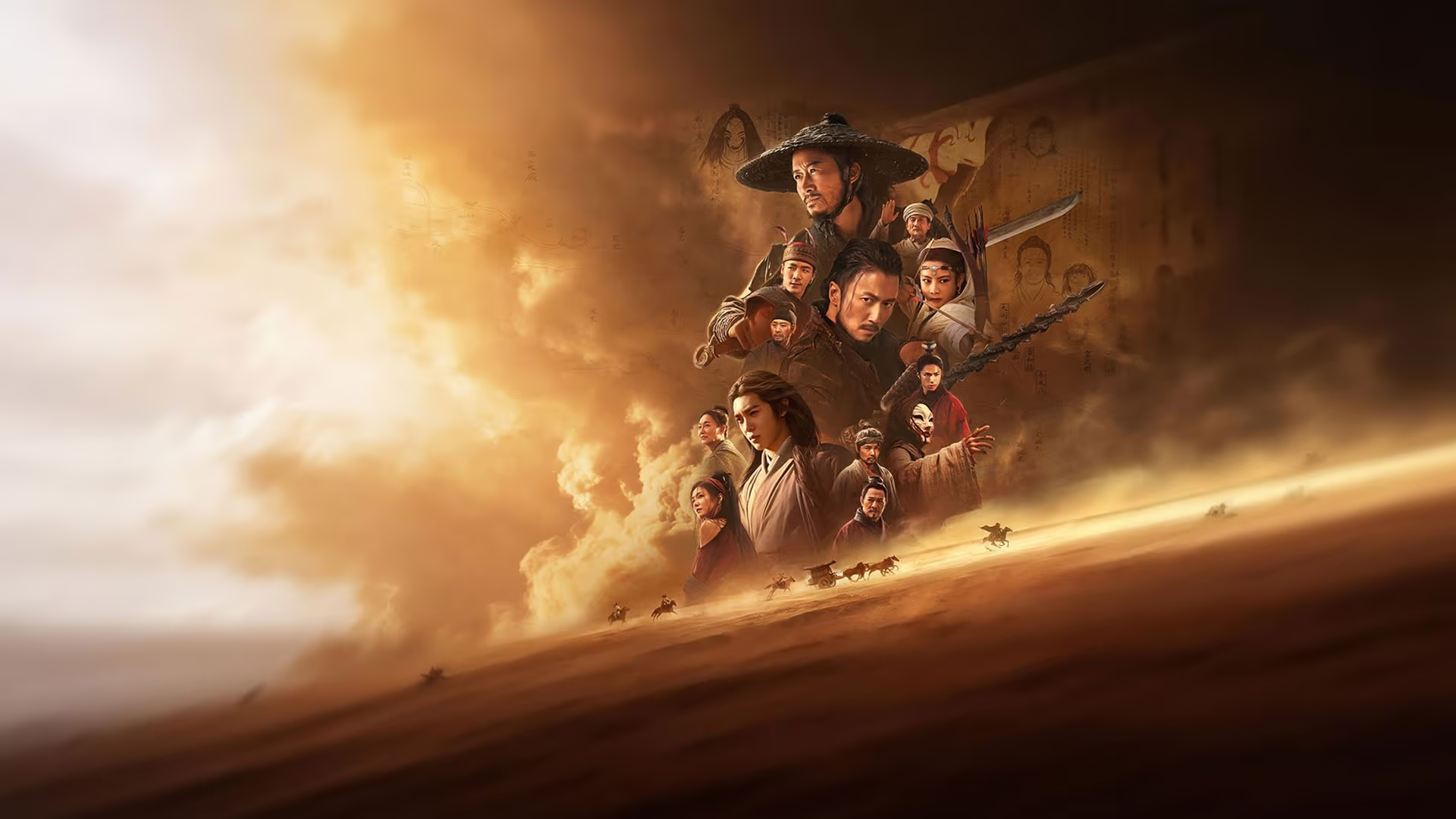
The recent release of Bi Gan’s third feature provides the opportunity to revisit his previous works and career so far. This retrospective is not intended to be an in-depth review of any singular work and is instead focussed on exploring common themes that have come to define Bi’s signature style.
This retrospective will engage with a range of works, encompassing early shorts and Bi’s recent features, culminating with a short look at his most recent release Resurrection. This retrospective will also set out the core components that have come to define Bi’s unique contribution to Chinese arthouse cinema. It will examine how his style has evolved since Bi’s first short to gain release The Poet and Singer first graced screens in 2012 and explore key themes in his subsequent works. While high-level in nature, please be advised this retrospective may contain spoilers.
The Poet and Singer
The Poet and Singer is a 2012 short predominantly shot in black and white centred around a murder which interlaces the plot with reference to the Diamond Sutra. This very text features prominently throughout. Bi uses lightening, shot in colour to mark flashback scenes to the murder.
The Poet and Singer introduces the locality of Dangmai, a fictional area which features heavily throughout Bi’s oeuvre and from which his production company takes its name. Bi also uses The Poet and Singer to establish poetic filmmaking in his oeuvre, using prose to interspace narratives often fractured by non-linear time. Both Chen Yongzhong (Chen Sheng) and Li Xunxie (Crazyface or Bad Bean) assume roles they return to in 2015’s Kaili Blues. While an early work, Bi’s willingness to experiment with long takes emerges in The Poet and Singer, a 100 second static shot helps the audience to feel the passage of time, in addition to another long take shortly after Chen Sheng and Bad Bean dispose of the body. The Poet and Singer gives audiencesthe first real flavour for Bi’s recipe for cinema, which he continues to refine to this day.
Kaili Blues
Bi’s first feature to receive general release Kaili Blues opens with a passage from the Diamond Sutra jin gang jing. This opening passage sets the scene for a film that will explore memory, its transient nature and dreams.Bi continues to interspace prose throughout, both of his own composition and inspirations.
Bi, by now an auteur of poetic cinema adds intensity to his oeuvre through this inclusion of poetry. Kaili Blues explores the past, present and dream life of Chen Sheng, a former criminal, sentenced for helping cut off the hand of a gang leader’s son. Although now working in a clinic, his life is disrupted as his half-brother Crazyface attempts to sell his nephew Weiwei.
Clocks feature prominently, a nod to the non-linear narrative of Kaili Blues, whether drawn on a wall or projected by a moving train they are a reminder that as time passes memory fades. Time repeats itself and the cycle continues. Non-linearity in Kaili Blues is not exclusively related to the appearance of clocks, with other commonly used motifs including locks and lockpicking, disco balls, shoes underwater, the lusheng (a musical instrument from Bi’s native Guizhou) and windmills.
Trains also help Bi to move the narrative in and out of dreams. One such example is when Chen is on the train to Zhenyuan, it is apparent that he has entered his dreams and he replays the day he was released from prison. This dream becomes lucid, with Chen journeying through Dangmai village to Zhenyuan.
In this dream, a 40 minute handheld long take accompanies Chen on his quest. Along the way he hitches a ride with a band on their way to a gig. Rainie Yang Cheng Lin’s Xiao moli plays in the background and is interrupted as Chen comes to the aid of an adult Weiwei, forced to stand in the middle of the road with a bucket on his head as a form of humiliation. It becomes evident that Weiwei has drawn a watch on his wrist, perhaps eluding to the fact that this is the same Weiwei Chen is searching for. Weiwei operates on his own time, separate from that of the outside world. However, Chen has the key to bringing Weiwei back to reality, this is symbolised by Bi through Chen’s ability to pick locks.
The long take introduces Weiwei’s love interest, Yangyang. Bi uses the long take to explore wider life stories, symbolised by the camera departing from Chen and Weiwei on the moped, and then continuing to follow Yangyang. As Yangyang prepares to return to Kaili, Weiwei proposes accompanying her, to which he receives no response. Although this appears to be a rejection from Yangyang, she later gives him a good luck charm to prevent his moped engine from dying. It is clear that Weiwei is unable to prevent Yangyang’s impending departure for Kaili, however he never gives up hope.
Weiwei desperately wants time to go in reverse. “Yangyang says she’ll only come back from Kaili if I can turn back time.” Weiwei takes her request literally. He draws clocks on all the trains in Dangmai, in the hope Yangyang will see them and believe Weiwei has turned time backwards as per her request.

Kaili Blues closes with a final scene comprising a 42-second take of Chen Sheng asleep on a train. In the centre of the frame, internally framed by the train window there is a clock, which has been superimposed on the train travelling on the adjacent line. The hands of the clock are moving anti-clockwise, a move which Bi uses to demonstrate that the timeline isn’t always as it seems. Indeed, at times it appears as if time is moving backwards.
Long Day’s Journey Into Night
Bi Gan’s second foray into full length feature making took the form of Long Day’s Journey Into Night. Originally marketed as a romance with the promise of a kiss at midnight, Long Day’s Journey Into Night quickly becameChina’s highest-grossing arthouse feature. It is perhaps too simplistic to write off Long Day’s Journey Into Night as a simple romance film, instead the film explores memory and time. Huang Jue’s Luo Hongwu searches for the remanets of his past, a deceased acquaintance, and a woman he thought he knew.
Bi innovatively blends 2D and 3D, with the audience prompted by Luo Hongwu putting on 3D glasses to do the same for the second half of the film.
Picking up the pieces of his past, Luo attempts to track down a woman played by Tang Wei. Bi’s masterfully deployed non-linear narratives add confusion to Luo’s memory, He struggles to remember the exact details of the person he seeks, embodied by Wan Qiwen, and later Kaizhen. The murdered Wildcat, played by Lee Hong-chi is a fading memory throughout. Appearing for two scenes, one of which Chen Yongzheng’s Zuo Hongyuan pushes his body into a mineshaft and another where Wildcat eats an apple whole, signifying great sadness and presumably foreboding his untimely demise.
This does not mean the film is unintelligible taking a step back there are clues that piece together a cohesive account of a dreamlike opening. The title card ushers in a 59 minute 3D long take, itself a cinematic marvel and in many ways the key to unlocking the first half of the film. Characters in this long take mirror those Luo Hongwu encounters or makes reference to throughout the first hour. Wan Qiwen, is instead replaced with Kaizhen, however, is a doppelgänger in this parallel dream world. Repeated motifs also help to ground the timeline, and provide additional colour to the storyline. For example, during Luo’s dream, a honeycomb pattern on a gate indicates that the Red Haired Woman, played by Sylvia Chang in fact embodies his mother, who left to have an affair with a beekeeper.
The soundtrack of Long Day’s Journey is a real standout, emphasising dream like non-linear structures, while also featuring many works true to the time those scenes grounded shortly before the turn of the millennium. For example, a karaoke scene where Chen’s Zuo Hongyuan sings Wu Bai and Karen Mok’s jianqiang de liyou to a captive Luo and Wan.
It would be remiss to overlook performances of Huang Jue, Tang Wei, Sylvia Chang and Chen Yongzhong. Chen, who has featured in all of Bi’s works stepped into his role as a baldinggangster seamlessly. Both Tang Wei and Sylvia Chang give convincing performances in both of their characters (dream and reality). Finally, Huang Jue arguably demonstrated the greatest commitment to his role, reportedly approaching Bi for a role having become a fan from Kaili Blues and learning Guizhou dialect to boost the authenticity of his narration.
A Short Story
In 2022 ,Bi Gan returned with A Short Story, a collaboration with Chinese cat food brand Pidan. A Short Story features a magical space cat with a dystopian existence. The choice of colour is reminiscent of Long Day’s Journey Into Night, while the narrator driven story bridges the gap in style between Huang Jue in 2018 and Shu Qi in 2025. Bi’s auteurism is evident, and this work signals an evolution towards a style that will become more pronounced in Resurrection. A Short Story’s soundtrack is more akin to the piano melodies that interlace Resurrection when contrast with Bi’s previous work.
Resurrection
Resurrection marks a different spin on Bi Gan’s signature style. It is apparent that Bi has consumed and taken influence from many historical works and intends for his audience to feel this through Resurrection.
While this article is by no means a review of Resurrection, there are common motifs that make a return from Long Day’s Journey Into Night. Li Gengxi’s Tai Zhaomei brings an apple to the last day of 1999, perhaps a nod to the act of eating an apple whole as a signal of despair in Bi’s previous work. Indeed there are familiar characters, at least in name, Huang Jue returns to assume the role of a vampiric Mr Luo, with Tai Zhaomei appearing as more than just a photograph. Bi, by now a veteran of the long take does not disappoint in Resurrection. In a move almost as innovative as a 59 minute 3D take, Bi incorporates a time lapse through the long take. This is by no means the only interesting cinematography with the film employing a range of aspect ratios throughout.
In sum, Bi Gan has created his own auteur style, embracing poetics through cinema and giving audiences pause for thought on what is dream and reality. Bi has set himself apart through his adoption of ambitious long takes and slow pacing, establishing him as a leading force in Chinese arthouse cinema. It is clear Bi’s style has evolved through his career, with his implementation becoming more refined and at the same time more ambitious.
While budgets have grown, Bi has kept consistency in his exploration of dreams and time. Common motifs return and the audience is under no illusion they are watching a Bi Gan film. It is no surprise that Bi continues to accrue an impressive flurry of award nominations and wins, most recently with Resurrection nominated for the Palme d’Or and winning the Prix Spécial at Cannes in 2025.
Some viewers may at times struggle to follow narrative themes in Bi’s works, however, if Bi continues in a similar vein to Resurrection his works are likely continue in accessibility.