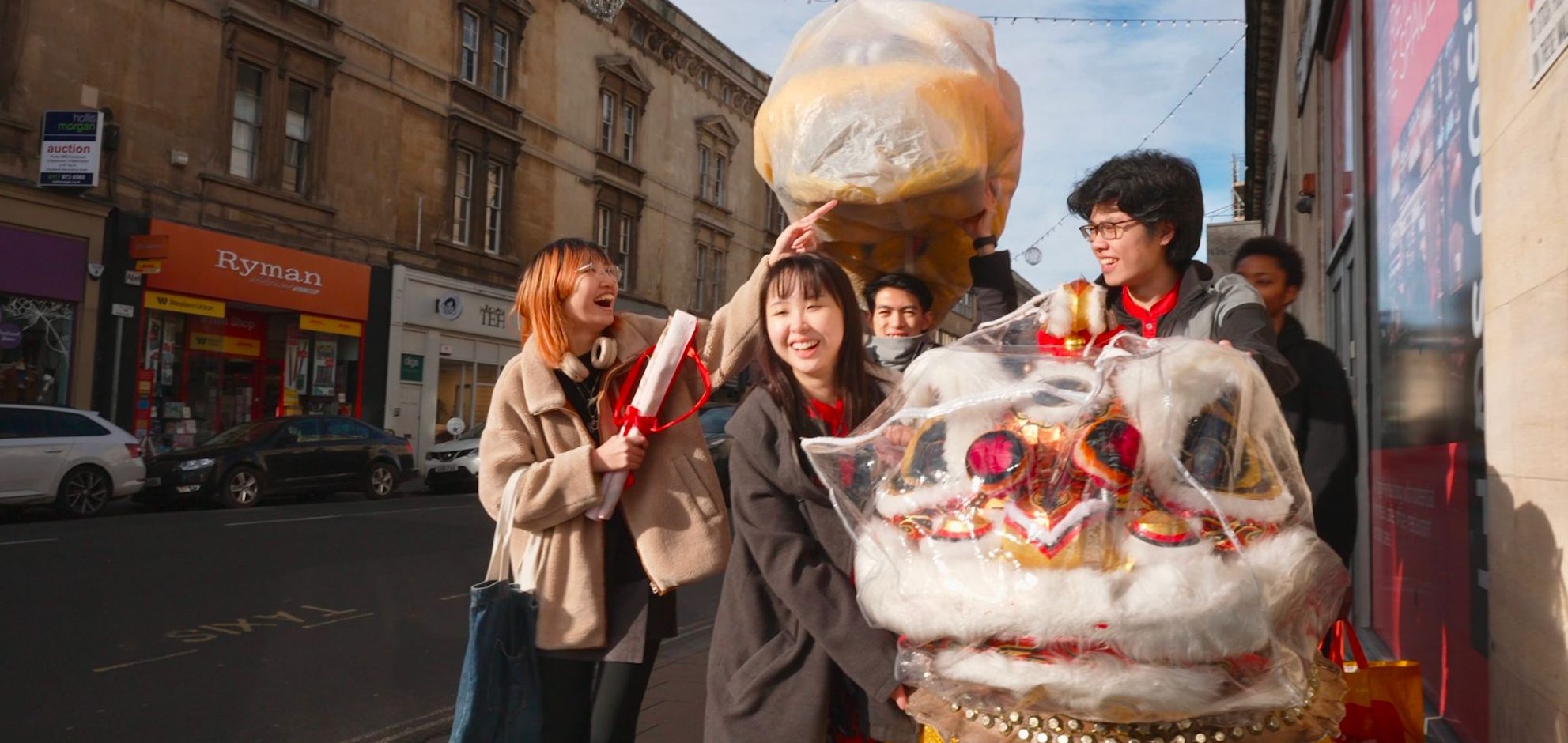
Bow and Rise, which won the “Audience Award”, the “Best UK-China Collaboration” and the “Best Made in UK Production” at the Odyssey film festival 2025, follows the UK’s only student-led lion dancing society in Bristol, exploring themes of belonging, community and identity.
Bow and Rise is a short film directed by Jasmine Mok, produced by Juliet Harper and edited by Megan Eyres, all filmmakers entering their final year at University of West England, Bristol.
Asma, Policy researcher at the UCFC, spoke to Jasmine, Juliet and Megan about their journeys into filmmaking, their experiences making Bow and Rise, and what lies ahead in their futures.
To start off, how did you all get into filmmaking?
Juliet: When I was younger, my sister and I would make YouTube videos. We grew up doing gymnastics, so we’d just record videos of it on our mum’s iPad and edit on iMovie.
I thought I wanted to be an engineer until I realised I was terrible at physics. There were so many different career paths I’d want to go down, different lives I’d want to live. I figured you get to do that with film. I studied Media at GCSE and A-Level, where I made a music video that got into a film festival – I had so much fun making it.
Going to a grammar school, it was very much instilled in us that I had to go to a Russel Group university to do a very academic course, so I initially applied to a Russel Group. I took a gap year, realising I didn’t want to just write essays about films, I wanted to make films. I reapplied to UWE Bristol, and I loved the course here!
Megan: I fell into film by accident. I’ve always been creative and was heading down an academic route, too. I was looking at studying history at university before dropping out of sixth form during COVID. I was struggling to find the motivation and was quite worn out from education.
While I was working during that gap year, I stumbled across a media course at one of my local colleges – I used to do some acting when I was younger and always enjoyed the filmmaking side of it. I picked up the course on the whim, and enjoyed it! I was suggested to go to university, at the time I considered myself too old, but turns out I’m not! UWE was local, and also one of the best universities for filmmaking.
Jasmine: I did the IB in Singapore before coming to the UK, so I had the option to do something creative in my course. I initially wanted to something related to art and design, but by speaking to people I realised it wasn’t a good fit. Film was available at my school, and gave it a go.
When I was younger, I also made short YouTube videos: I’m not sure if it sparked my interest in film, but something in me really wanted to try it. After the IB course, I decided to do it in University too, since I’ve always wanted to do something really hands-on and creative.

What pushed you to make a documentary about lion dancing specifically?
Jasmine: When I came to the UK, I didn’t have many friends, and I was feeling lonely. I felt really left out because I wasn’t familiar with the culture, so I looked for something to do on the weekends and stumbled across Lion Dance Society. I grew up watching lion dance, but never really thought of doing it. It was something that connected me back to my own culture so it holds a special place in my heart, and I feel very at home doing it with the friends I made.
I assume many people in the UK haven’t really seen lion dance, so I wanted to share it with a wider audience. During first year, I made a three-minute version of the documentary just to experiment with, and to see whether people would be interested to learn about it, which they were! I decided to bring it up again for our second year project, and brought in other members like Juliet and Megan.
For Megan and Juliet, why were you two interested in this film project?
Megan: As said, not many people knew what Lion Dance was, and I didn’t have a clue— for the longest time I kept calling it Dragon Dance, which it definitely isn’t. It was so interesting to learn more about this culture. I’ve lived in Bristol my whole life and never knew that this dance troupe had been on my doorstep for over 30 years.
I was so interested to see what they do, learn something new, plus it’s so visually captivating and the members were so passionate— there was no way I was going to pass up on this opportunity. Before we even started the process I went to a meet and greet with the troupe. They welcomed me in so lovingly, and I became part of the troupe straight away. I’m glad we’ve managed to get their stories out there because they really deserve it.
Juliet: Jasmine really sold it to us! From the start, it seemed like a really interesting story, and as we were making the film, we had so many ‘eureka’ moments, so many turning points — we really had enough ideas and footage for a feature film.
The original story is so interesting, and the film’s message is a universal one relating to new beginnings, and finding a home away from home. We all really found an appreciation for that culture, and felt a part of it by the end.

There is a really strong and intimate sense of community that the audience can see throughout the film, for example when Nicole is dyeing her hair with her friends. Were these scenes difficult to film due to the intimate nature of them?
Juliet: Ben, our camera man, was really brilliant, and he was able to build up such a great rapport with everyone that he could seamlessly go through the group filming in a way where people almost didn’t realise he was there. They knew Ben so well that it was like another friend supporting the troupe, rather than a ‘camera man’. He immersed himself in the troupe so well, so everyone ended up feeling comfortable with him sticking a camera in their faces.
Megan: We were such a small crew that our presence wasn’t really overwhelming. Everyone on the troupe was just so charismatic, we didn’t really know where to put the camera! At the start we didn’t consider to have Jensen as a participant but he was so mesmerising that we had to include him— all our shots were of him!
I think it really helped that we were similar— they were students, we were students, so we all became friends really quickly. We went for dinners outside of filming, went to all of their performances, hangouts, and captured whatever we could. God, I spent months editing the footage and there’s so much that I wish everyone could see!
Juliet: Having Jasmine in the crew was our way into the troupe, she acted as a bridge for us to walk across seamlessly, which made it easy to get along with everyone. Without Jasmine, we wouldn’t have been able to make this documentary.
How long did you film for in the end?
Jasmine: The whole production spanned across around half a year.
Megan: It was part of a university module, so we were limited by deadlines. But they kept extending the deadline, which worked in our favour as we were able to use the extra time to film the Chinese New Year performance, which is what the troupe was working up towards in the year. We were so lucky to film the New Year performance – it was two days before the hand-in date, so we were editing like crazy. We managed to get a good five, six months of their lives into these eight minutes.
We started shooting as early as we could, first with the main interviews to get an idea of their stories, and so they could warm up to us. We did want to show the more rebellious side of lion dancing, as the troupe itself trains in an unorthodox manner too. We wanted to push this narrative that they were in a way rebellious, creating their own version of their culture in a new place. With Nicole’s hair dyeing, she felt like doing something rebellious, so we went along and filmed it. Jayson’s story is so powerful, too. We could’ve made this ten hours long and followed them forever!
I was really please to see many people of different background in the troupe, who weren’t necessarily of East Asian descent – it seems like quite a welcoming space.
Jasmine: Definitely! Lion dance originated from Hong Kong, Malaysia, and other areas, so many would think that our troupe is exclusive. Some people have even asked if we only speak Chinese during practice, but the truth is we have people from all across the world. We have local students who join us as well as Chinese and Malaysians – everyone is welcome because we want to share this experience and the art of lion dancing to as many people as we can. It’s a very welcoming environment.

Why is the only student-led lion dance society in Bristol? The spirit of Bristol as a city is quite creative and fun, so maybe that’s a reason.
Jasmine: There used to be more university troupes in the UK, but many disappeared due to COVID. In fact, the one at Bristol was close to vanishing, but one member kept it alive. It was a one-person team, and he was recruiting his friends to join, just to keep this art form alive in this creative and colourful city. It’s a joy to know that it’s alive and thriving right now, and with this documentary, even more people can learn about it.
Why is the film called Bow and Rise?
Jasmine: Bow and Rise are these lion dance sequences in the music that we do at every performance from the beginning to end. We followed their journey from the start of their practices to the end, which was the grand finale performance at Chinese New Year, so it felt like a clever nod to the lion dancing.
Finally, do you have any upcoming projects that we should keep an eye out for or anything in the works
Megan: We are starting to form our graduate film ideas and forming groups that will eventually lead to our final projects for this year. I have a big passion for documentaries, and am hoping to centre myself about documentaries in my career
Juliet: In the future, I’d love to make more documentaries. I’m really interested in politics, geopolitics, so I’d love to tie documentary making into that. Even with Bow and Rise, there were moments where we felt we could’ve tied it in with politics. I just love the creative input I have in a documentary – it feels like there’s three versions of the story: the one you envision initially, the one you shoot, and the one after the edit.
Jasmine: I have an idea that I might make in the upcoming modules about foreigners living in the UK, based in Bristol. It would follow a Japanese lady making her own clothing business here in Bristol, so I’m excited for that.
Bow and Rise is a short student documentary that follows the Lion Dance Troupe at the University of Bristol as they gear up for their Chinese New Year performance. The film explores themes of community, self-expression and culture.
Check it out here: Bow and Rise at Odyssey
Follow their Instagram for more updates: @bowandrisedoc
Photography by Lola Lee, Louis Lingjaerde and Elsa Wu.
Asma Waheed is a journalist and film reviewer at Private Waves. Alongside acting as PR Lead for Odyssey Film Festival 2025, she is a policy researcher with the UK-China Film Collab.