This interview was conducted by Selena Wang and Christina Jiang.
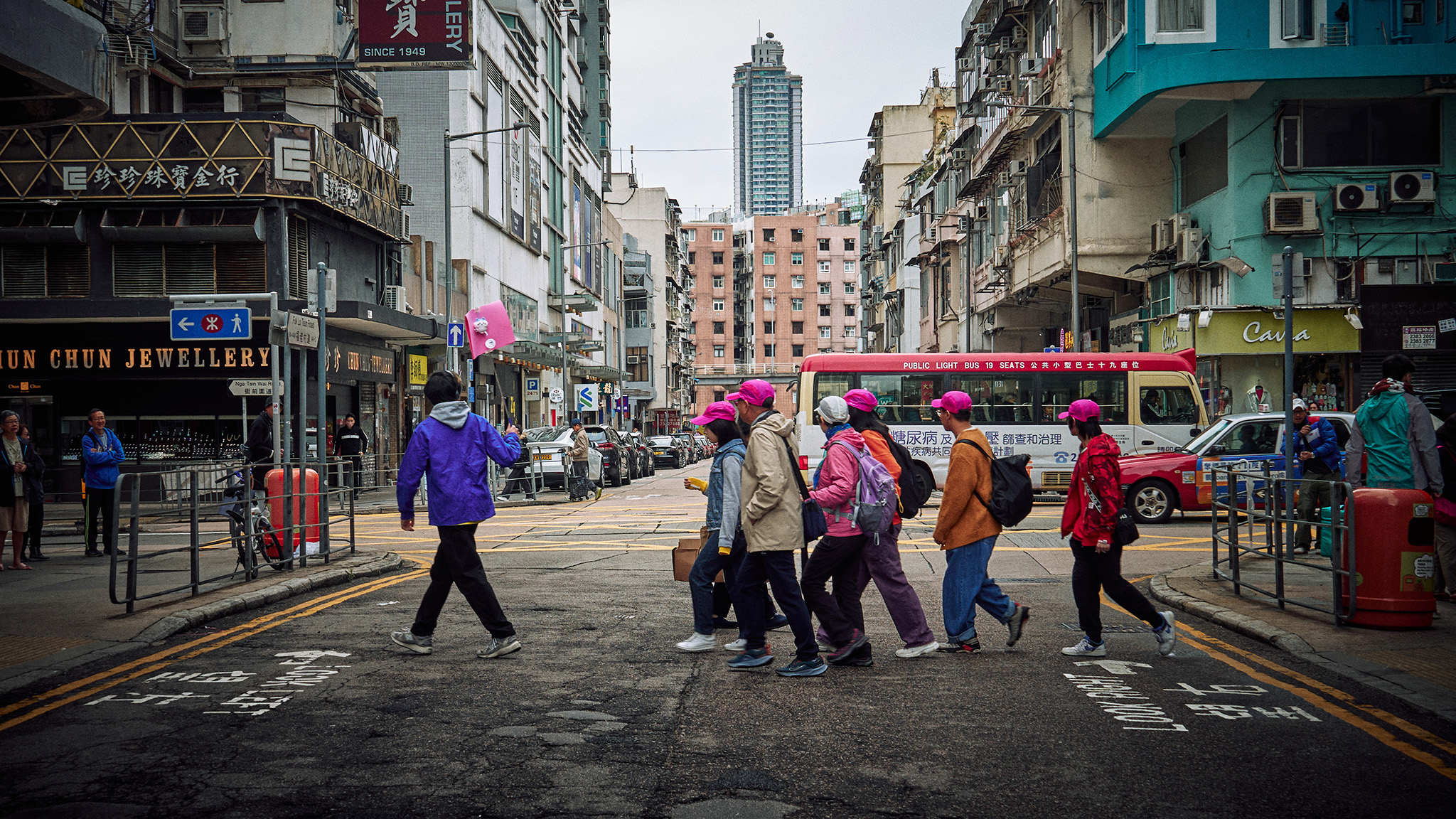
Panning from a tour guide testing his microphone, to tourists deciding on a cafe, to a camera operator hurriedly scouting for locations, this comedic single-take filmed from a rooftop in Kowloon City, Hong Kong, moves between rehearsed, reenacted, real, and all the way back again. Who’s watching who, and if everyone is both watching and performing, who gets to frame the truth?
—IFFR

First, could you tell us a bit about yourself and your journey as a filmmaker?
I’m Sheungman, Hong Kong-born, raised in the UK, Hong Kong, and the States. I studied in both the UK and the States.
I started off as a researcher and scriptwriter, then slowly moved into independent filmmaking and making short films. At the same time, I was writing scripts for other directors. I transitioned into script translation and interpretation. I did my MFA rather late in life, at CalArts — this short film is actually my thesis work.
Currently, I’m developing my first feature film — it’s just been selected by the Hong Kong HAF (Hong Kong Asia Film Financing Forum).
People like the historical image of the Kowloon Walled City before its demolition — your film is quite unique in being set in that area in the modern day. What draws you to Kowloon City?
I only moved to the Kowloon area about six years ago, with my then partner, now wife. I slowly became familiar with the neighbourhood, and became fascinated by this anachronistic quality within the area, with the people. I did some digging, and I was really shocked by what happened during colonial times. But no one cares about the local history — life goes on as is.
I feel like that captures some of the characteristic, the essence of what a Hong Konger is. That hybrid quality — a stronger word would be a bastardised quality — of Hong Kong, its history, its people, the community. I feel like I have to express it. Even though times have changed, the people have changed, and the community and landscape have changed a lot, I feel like human nature itself is more or less the same.
That’s why I wanted to make this short. Because people get obsessed with ‘truth’, but especially nowadays, the truth isn’t something we can say out loud, even if we’re witnessing it.
Near the film’s start, a tour guide jokes to his group that when the Walled City was demolished, everything ‘unclean’ was washed away with it. So would you say your film is disagreeing — you’re saying, ‘actually, not much has changed’?
I would say definitely not much has changed, if it’s not worse! This kind of cultural tour around the remnants of Kowloon City does exist. My friend is a tour guide for these cultural tours, and they’re gaining popularity now because of that film, Twilight of the Warriors: Walled In 《九龍寨城之圍城》 (2024), a kung fu gangster film. A lot of mainlanders are here for that, even though they won’t actually see anything that appeared in the film.

You touched on the idea of ‘truth’. The film contains a lot of false doubles. In particular, there’s the contrast between a beggar faking blindness, and the news crew’s ‘fake truth’ of a blind actor re-enacting him. What draws you to this idea of fabrication and truth?
These different events actually happened, just not at the same time. First, there are many fake hustlers and beggars around the streets of Hong Kong whenever the economy isn’t doing well. When I was growing up in the early ‘90s, there were a lot of beggars on the street corners. My aunt would tell me they were mainlanders who had been kidnapped and had their limbs chopped off, thrown on the street to beg for coins and used as a tool to make money. There’s a lot less now, but it wasn’t uncommon back in the day. When COVID just ended, there was another wave of beggars hustling on the streets.
Then, ‘fake news’ has existed for a long, long time. The news crew boss in my film is actually a journalist, and he told me that in journalism, they don’t call the news ‘news’ — they call it a ‘story’. And they’ll always think up stuff to make their stories more compelling. So having a fake beggar reenact an authentic beggar is nothing new. I would say it’s part of their practice.
For example, in 1997 or 1998, the Hong Kong newspaper Apple Daily actually paid a guy to enjoy services from prostitutes, and had it make the news. His wife committed suicide, and her suicide made the news too. But who anchored that in the first place?
This has existed since the birth of journalism. I felt it was important to include it, and I combined these in a kind of playful and funny way to have in my film.
The news crew in your film essentially plans to ambush a beggar for faking blindness, but by the end, the crew boss is shown to be unable to recognise a person as blind anyway. What are your opinions on the news and the ethics of how they choose their stories?
Denzel Washington has this great comment on the news: ‘If you don’t watch the news, you’re uninformed. If you follow it closely, you’ll be misinformed.’ It’s a great quote, nowadays especially.
We’re accustomed to watching the news and assuming that they’re telling facts, if not truth. That’s why I chose to shoot the whole film from a high angle, as if I was just picking up events by accident, like a Youtuber shooting through an iPhone. Institutions like news channels aren’t as powerful as they used to be — Youtubers, vloggers, and bloggers are actually becoming more powerful and informative than most news outlets. That’s how I see the news today.
Of course, I live in Hong Kong now, heavily influenced by the politics of China, so I always watch the news with a grain of salt. I feel like you watch the news, then go to online forums to see how people comment on it, and that’s how you get the actual news.
I imagine you might have needed filming permits. Yet these days, it’s popular to have YouTubers approaching people in public, sometimes without their consent. Where do you see the differences between live filmmaking and a news crew?
You know what’s funny? Nowadays, if you’re shooting something on the street in Hong Kong, if the police come up and ask, ‘what are you doing?’, and you say, ‘I’m just making this for my YouTube channel’, they’ll just walk by, they’ll let you go.
But if you’re shooting something with a crew and you bump into the police again, and you tell them, I work for this certain news channel, then they’ll become really suspicious. In a place where presumably we have the freedom of press, it’s ironic that being a YouTuber actually gives you a lot more freedom than some independent news outlets.
Your film touches on several Hong Kong issues: unemployment rates, the treatment of ethnic minorities, and the press. Most noticeably, it’s set during the district councillor elections, with campaign announcements blaring in the background. Why did you set it during that period?
You guys are actually the first ones to pick that up. Whenever there’s a district councillor election, they have these propaganda vans going around Kowloon City. It’s honestly quite distracting and loud, more of a commotion than anything. But I feel like it’s really interesting — it adds something chaotic, the noise of it. I like it when there’s too much noise, when the whole soundscape is so saturated that you don’t actually hear anything. That’s how I decided to use the propaganda promotion slogans of the council election.

The film has a very clean visual premise, consisting of a single overhead long take. The camera pans over all these unrelated characters in an equalising, centreless way, capturing the chaotic coincidences of a city view. What attracted you to that idea?
It was inspired by a short film, Incident By A Bank (2010), by Ruben Östlund. The film is a reenactment of a bank robbery he saw in ‘08. When I saw that film, I felt that was the right form to tell my story. But I would say my story is much more complex in terms of its choreography. The choreography is mostly influenced by Jacques Titi’s Playtime (1967). It’s a brilliant film, he went bankrupt making it, you should definitely check it out. There’s also Charlie Chaplin’s short stuff — funny and ironic things. If you watch Incident By A Bank and Playtime, you’ll know right away that I ripped them off! But I think it’s totally okay.
It clearly took a lot of choreography to shoot. Was it actually done in just one shot? How many takes did you do, and how did you manage to coordinate people? Did you use a radio?
Yes, it was actually done in one shot. We did seven takes the day we shot it. We rehearsed in the morning, took a break for lunch, and then did our first take around 1:00PM. Not quite what I wanted. Then we did six more. And then the sun was going down, so that was it — the final film is the seventh take.
We only rehearsed that weekend, but I planned the whole thing about two months earlier, once I decided to make the film in this form. There’s this saying — when you don’t have a lot of money, you have a lot of time. I actually recorded myself walking on those streets many, many times, with the camera on the rooftop.
I recorded the pattern of the traffic lights to see how many seconds it takes for them to switch to yellow then red, and when and where each light changes, so that I’d know when the pedestrians will cross. It could be a documentary in itself. On DaVinci (the editing programme). I put those sequences together to see how long it took and reverse engineer the patterns of the traffic lights, and pick a particular time to start the camera so that each actor will hit their mark at a particular moment.
I recorded at different times of day to find out when it’s the most crowded, and when it’s more empty. The day we actually shot was a Saturday, with the Rugby Sevens going on maybe a mile away from where we shot. I knew it would be crowded after lunch, so we used that to our advantage — it meant I had a crazy amount of extras who wouldn’t know I’m shooting from the rooftop. After our rehearsals, the crowd appeared, and the time came to use our natural resources.
There were several groups of actors. I gave them walkie-talkies and instructed them live. I didn’t have to control them, but when stuff happened, I reminded them: ‘this guy is going to pass you in three seconds, pretend you don’t see him.’ After many rehearsals, they knew where to go and who they’d see. My cinematographer stayed next to me and I would tap him and tell him, like, ‘stop right there’, and ‘follow this guy!’, stuff like that. After rehearsing it maybe ten times, he understood what I wanted, and I let him do his thing.
There was one thing that put us in a pickle — do you remember the moment where the assistant picked up the box and ran across the street to the actual blind guy? In that moment, the traffic light turned red ten seconds earlier than we expected, so he was in a dangerous position when he ran back to his boss. But otherwise, if not complete control, most of it was in the range of control. It was more like a science project than an art project.

I’m really curious — with that many run-throughs, how many balloons did you use? They float up perfectly over the buildings to indicate when the balloon-sellers are fighting at street level.
Not more than ten, because we only ordered fifteen. At the start of the shoot, we accidentally popped like five of them, so we only had ten left before the shoot even started. So I told the guy who holds the red balloons — hey, man, please don’t mess up my shoot. Please, please protect them like your own child. I can’t get more.
Also, they were red and green, right? At some point, we only had three red balloons left, and a bunch of green ones. I thought, if the red ones all pop, we can still use the green ones and then key the colour back to red in post. We actually thought about doing that at one point. That’s actually a really good question.
You said you had the camera on the rooftop. Its zooming and adjusting seems to mimic how a camera would work for a live news crew. Was it difficult filming from such a distance?
The Director of Photography did a great, great, great job capturing the actors. The timing of when you’re not seeing them is actually really important. At certain moments, certain characters have to be out of frame so they can run to the next location — so kudos to my cameraman.
Sometimes, I want it to look like there were accidents or unexpected elements. I don’t want everything to be too on the nose, because it would look less interesting, less exciting.
How did you record the audio?
The guy in the yellow bucket hat who plays the fake beggar is also my audio guy. We had lavs (clip-on microphones) for the actors and actresses with more dialogue, but most of it was unusable — we just used them as reference and did 90% of it in post. But having picked up the actual sound from the environment helped us a lot. When we recorded dialogue in post, I actually asked them to go back to the street to record it instead of doing it in the studio.
I feel that the sound in general is very Robert Altman-ish. He likes having ten people talking at the same time in one scene. This is what trips me up the most now that it’s done — I would have preferred even more sound in the film, to the point that you can’t really understand it, that you have to lean in to listen to what they’re trying to say.
I enjoyed the style of the film: the music, the humour, the way the credits are done. It’s very fun and fresh. You’ve mentioned Ruben Östlund and Jacques Titi — what other stylistic inspirations do you have?
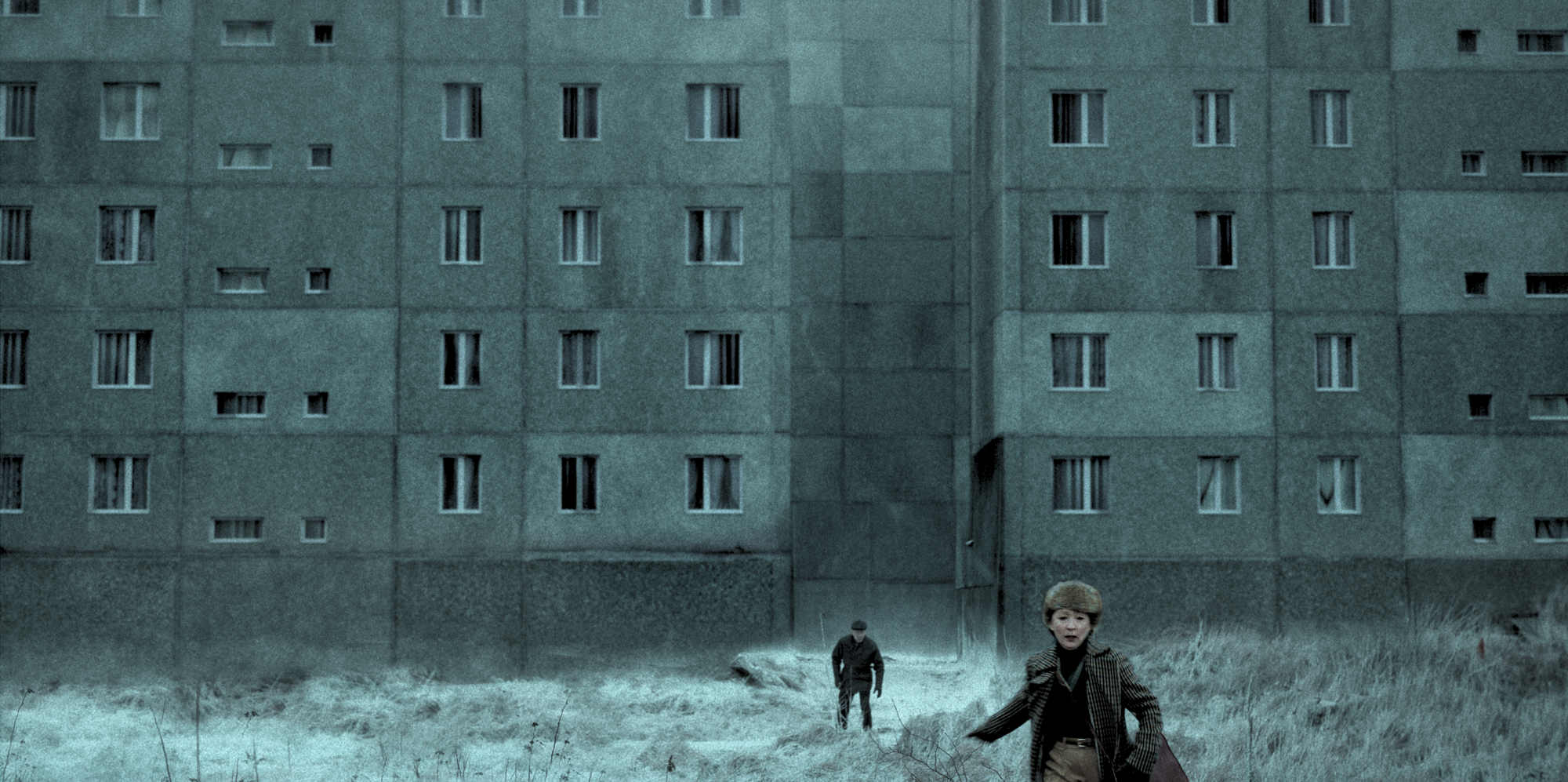
I always love films that make you wonder, am I watching a documentary, or am I watching a narrative film? I would say one of my movie gods is Michael Haneke. Of course, his films are a lot more suspenseful. He made Code Unknown (2000), and then Hidden (2005). I think in French it’s Caché. It’s about a guy who receives a videotape shot from an impossible angle, framing the place he lives, who tries to figure out who this peeping Tom is. It traces back to some kind of white middle class guilt. It’s a very haunting but interesting film in terms of form. I find it really inspiring — I revisit it every other month and still draw a lot of inspiration in it.
I am immensely interested in spectatorship: What are you watching? Is it a reenactment? What’s the point of re-enactment? Michael Haneke is a major inspiration.
Can you tell us about your choice of the song for the opening and credits?
The song is ‘DragonTown II’ (龍鎮Pt.II) by the Hong Kong rapper YoungQueenz. I think the rapper is a genius. If you look up the lyrics, it’s actually about Kowloon City, but with an interesting postmodern interpretation. This song is about how he’s so proud of being a resident of the Kowloon Walled City, but it doesn’t exist anymore. So his interpretation is, the Hong Kong zeitgeist right now is like the Kowloon Walled City — he thinks he’s going to die young, but he’ll live a vivid, exciting life in this modern Kowloon Walled City. And I kind of feel the same. It’s very provocative, and that’s why I picked it.
Music video with english subtitles here
Lastly, you mentioned you’re currently working on your first feature. Can you tell us anything about it, and when it’s expected to be out?
It’s kind of tangential to this project — I’ve been tracking ethnic minorities in Hong Kong. There are South Asian communities, but I am very close with one particular African asylum seeker family, who have now moved to Toronto as of last year.
Since asylum seekers can’t get a proper job without an identity card, one way some of them survive in Hong Kong is by breaking into empty houses, around the Kowloon City area and elsewhere, picking up things that are worth pennies. I don’t know who they sell it to. But there’s one particular thing they pick up which I find really fascinating: they’ll look through the drawers of vacant houses to look for bank statements, electricity bills, water bills.
They sell those to the local gangsters, who sell them online from Taobao, where mainlanders buy it as a proof of address so that they can apply for better schools for their children in Hong Kong, and claim that this is their Hong Kong address to qualify for this or that. I find that idea, of someone who goes without an identity forging an identity for someone else, really fascinating.
That’s the feature film I’m developing right now, about their life. There will be some spiritual, ghostly elements later in this film. It’s kind of a continuation of my Walled City narrative. It’s still in the development stage, so it’s not 100% concrete, but I think it will be one of the first Hong Kong films with African refugees as protagonists.