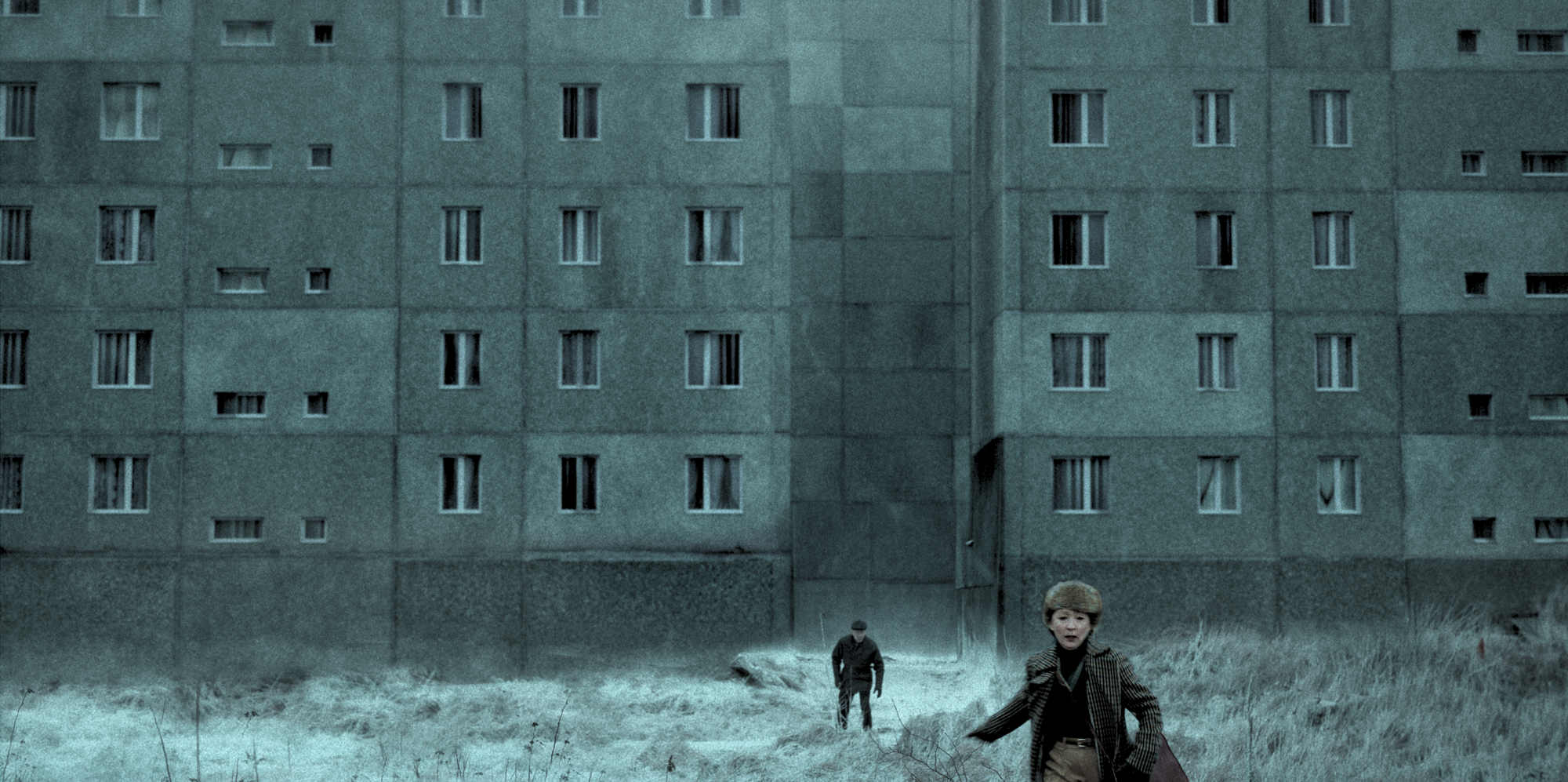
Infanticide, directed by London-based Chinese filmmaker Veronica Wang Jingyi, follows a queer filmmaker who returns to her hometown of Hangzhou with a screenplay, casting her divorced parents in scenes drawn from their real-life conflicts. The film was selected for the “First Frame” section at the FIRST International Film Festival 2026, a programme dedicated to foregrounding women’s experiences and representations on screen.
In the 20-minute short, Wang turns the camera on herself and her parents, revisiting a family story she has never been able to let go of. Blending documentary observation, reenactment and self-reflexive filmmaking, Infanticide transforms an intensely private confrontation into a poignant exploration of parental authority, emotional repression and the uneasy coexistence between two generations.
In this interview, Wang reflects on using filmmaking as a safer way to reveal her true self to her parents, the ethical dilemmas of turning the camera on others, the hybrid form and dark humour of Infanticide, and why accepting that reconciliation may never fully arrive has ultimately brought her a different kind of peace.
“The director in me feels safer than a daughter!”
Tilda: Your academic background is not in filmmaking. How did you begin making films?
Veronica: Whenever I am asked how I became a filmmaker, I sometimes hesitate, because I am still not sure whether I can call myself one. If it means someone who earns a living from cinema, I do not think I quite qualify. But if it means someone who is committed to creating films, then I hope I am becoming one—and perhaps I already am one in some sense.
My path has been quite unconventional. I never attended film school. I was more interested in social observation and social theory, so I studied anthropology, field research and cultural studies all the way through to a PhD at University of Cambridge. But the desire to create was always there. I had wanted to make films since childhood. When I was conducting fieldwork in 2021, those two sides of my life finally collided.
I took ten days out of my fieldwork to make this film. We had perhaps five or six days of preparation and five days of shooting. Everything came together extremely quickly. It was my first opportunity to practise being a filmmaker—or simply being someone who makes films.
Tilda: Rather than turning your research subjects into the subjects of the film, you turned the camera on yourself. Was that a conscious decision?
Veronica: Yes, and I think that is a very perceptive way of putting it.
If I were to film the people I study, I would be deeply concerned about the power relationship involved. I would constantly question whether I could maintain the necessary ethical distance and whether I had the right to speak on their behalf. These are longstanding questions in anthropology. I did not want to become someone who might potentially exploit other people simply by holding a camera.
By turning the camera on myself—and, eventually, on my parents—I could at least expose my own vulnerability. I could dissect myself and draw the material from there. For a first attempt, that felt more honest and more comfortable.
Tilda: Was the hybrid, self-reflexive form of Infanticide conceived from the beginning?
Veronica: Yes. It was part of the film from almost the moment I decided to make it. The accidents that happened during production were real accidents, but the overall meta-cinematic structure was planned.
The idea initially came from anger. I had had an intense argument with my parents and thought, “I need to write this down.” I wrote through the night, but gradually realised that documenting one argument was not enough. The more I wrote, the more I understood how much I wanted to uncover.
I felt that I had to use a film-within-a-film structure to record it. Perhaps that reflects the limitations of my fictional imagination, because many of the things my parents give me in the finished film are not things I could ever have written in a screenplay.
Tilda: Did the presence of the camera intensify your parents’ reactions?
Veronica: It depends on what we mean by “intensify.” I did not deliberately provoke them. I was not treating them like animals in a zoo or manipulating them into performing a spectacle. To be honest, my parents are not people who could easily be manipulated by me anyway.
But the camera did provide an entry point. In that sense, it invaded our reality. Communication between my parents and me has always been strained. At that time, they did not know that I had wanted to become a filmmaker since childhood. It was a secret I had carried for years because they were very strong and authoritative figures, and I was afraid to tell them.
When I invited them to make the film, the “provocation,” if there was one, came from my attempt to show them who I really was. Filmmaking became an entrance through which I could reveal myself to them. For many Chinese parents, simply seeing their child’s authentic self can already be an enormous shock. It was like having a wound that I had never dared to show them.
I needed the camera to maintain a certain distance. By saying, “We have a film to make,” I could place everything within a working structure. Only then did it feel safe enough to reveal my real thoughts and my wounds. Telling them I had a project was easier because it followed a logic they could understand.
The director in me feels safer than the daughter. The director has more power and is more equal to them. Even now, the daughter in me sometimes has to hide behind the director because she remains afraid of facing them.
Tilda: Was making the film therapeutic for you?
Veronica: The meaning of the film changed through several stages.
At the beginning, it was an extremely direct form of release. During the month when I started making it, I was venting. I certainly had not thought as deeply as I later did during the editing process.
During the shoot, however, the film allowed me to expose a part of myself to my parents that they had never seen before—my creative self and my genuine thoughts. The camera did not merely intervene in the life shown on screen; it intervened in my actual life.
Editing the footage repeatedly also helped me understand my parents’ perspectives more clearly. Understanding where they come from does not mean that reconciliation must follow. Reconciliation suggests that different paths eventually intersect at a shared point. I am no longer sure that our paths will ever reach that point. But perhaps they do not have to. Perhaps three lines can continue without intersecting. What I can change is my attitude towards the fact that the three of us may never meet completely. I no longer see that as an unbearable tragedy.
The film brought me to that realisation. Previously, the situation felt painful and hopeless, and I desperately wanted to change it. The reality itself has not necessarily changed, but my relationship to it has. By presenting that realisation on screen, I also wanted to share it with viewers. I believe many people have had similar experiences. Perhaps the film can help them look at those experiences without remaining completely submerged in the pain.
Tilda: The title Infanticide immediately suggests something extremely dark. The film does not avoid that darkness, but its eventual tone is lighter and contains several twists. How did you arrive at that balance?
Veronica: The title was there from the very beginning. I knew it would evoke many associations and perhaps lead to certain misunderstandings. But the tone of the finished film reflects the emotional place I reached during the editing process.
My father, for example, recounts something profoundly serious in an almost casual manner: when doctors suggested during my mother’s pregnancy that I might have a neurological condition, he considered drowning me after I was born. I wanted to explore whether such a heavy subject could be approached with a degree of lightness without diminishing its gravity.
There are already many emotionally intense films about intergenerational trauma. I wanted instead to bring out the absurdity and black humour embedded within that experience. The tone also reflects where I am now. I went through a period of being completely immersed in the pain, but I no longer want to remain there.
Tilda: You have spoken about how much your cinematographer, Feixue Tang, supported you professionally. What was your collaboration like?
Veronica: I am extremely grateful to her. She was the most experienced professional in our crew. Despite that experience, she entered a production led by very young and inexperienced creators without becoming impatient or dismissive. Instead, she adapted to us generously.
Perhaps working with younger filmmakers also nourished her in some way. She was moving from a mature professional environment into a project driven by raw energy. She liked my idea—we spoke on the phone before the shoot, and she joined because the project genuinely interested her. She also offered us the lowest fee she could, making it possible for us to afford her involvement.
Once she arrived, she was completely invested in the creative process. She often recognised moments that needed to be recorded without waiting for my instructions. Towards the end of the shoot, when I went to film my mother with the second camera operator, she decided on her own to interview my father. Those interviews produced fascinating material.
Tilda: Do you see yourself moving towards fiction in the future?
Veronica: I have been thinking about fiction for a long time. There was originally a 60-minute cut of Infanticide. Although we only filmed for five days, the cameras barely stopped, so we accumulated a great deal of material. I reached a point in the edit where I felt stuck working on it alone, so I submitted the longer version to several documentary labs. The main feedback was that I should continue filming. Because everything had happened within five days, people felt the film needed greater depth and a longer span of time. For various reasons, I was not ready to shoot again.
I therefore decided to see whether I could make a 20-minute version that concentrated on several ideas I most wanted to express. I am quite happy with the result, but I have not abandoned the possibility of developing the remaining footage into a feature.
Five years have passed. I sometimes wonder whether I should return and film again. The temporal scope would suddenly expand from five days to five years. I could completely overturn the structure of the short, and the original footage might become almost unrecognisable within a new film.
I would also like to make a fully fictional film. I imagine it would be immensely satisfying, although also more challenging. Documentary requires reflection and the ability to face yourself truthfully, which is relatively close to my academic training and therefore within my comfort zone. Fiction seems to demand another level of technique and invention. I may need formal training before taking that step.
______

FIRST International Film Festival, a film festival-style service platform in Xining, China, focuses on discovering and promoting young filmmakers and their works.